
BNC Connector Overview: History, Standards & Key Features
The BNC connector is a miniature coaxial RF connector designed for quick connect/disconnect for coaxial cable. Its distinctive bayonet locking mechanism allows for a secure, positive connection with just a quarter twist, making it ideal for situations where frequent connections and disconnections are necessary.
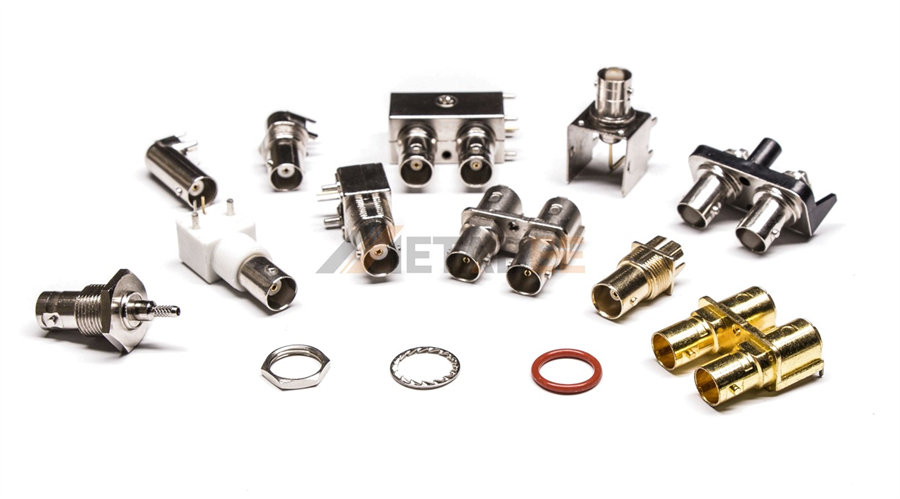
The acronym "BNC" in BNC connector actually stands for "Baby Neill Constant." However, most people mistakenly believe it stands for "Bayonet Neill-Concelman," which is incorrect.
While Paul Neill and Carl Concelman developed the Type N and Type C connectors—which influenced the creation of the BNC connector—they were not directly involved in its development. The misconception likely arose because Neill and Concelman later designed the TNC connector (a threaded version of the BNC connector) in the late 1950s. As a result, many incorrectly assumed they also invented the BNC connector and attributed the name "Bayonet Neill-Concelman" to it. In reality, this was not the case.
History of the BNC Connector
1941: The U.S. Navy adopted a smaller version of the threaded N connector, called the Type BN (Baby N), for use in military equipment (designations: UG-85/U, UG-86/U, UG-114/U, UG-115/U).
1943: The British introduced a ¼-inch 50-ohm coaxial cable, prompting multiple companies to develop new connectors for it.
Early 1944: The U.S. Navy sought a standardized connector design. Paul Neill (inventor of the N connector) created a prototype with:
- 50-ohm impedance (stable above 1 GHz)
- A bayonet fastening (faster than threaded connectors)
- Easier manufacturing and assembly
April 1944: The Navy modified Neill’s design, renaming it BNC (Baby Neill Constant) to reflect its constant impedance. It was assigned military part numbers:
- UG 88/U (male)
- UG 89/U (female)
December 1944: The Navy finalized the design in drawing RE 49F 246.
Standards
The widespread adoption of BNC connectors has led to the establishment of several industry standards to ensure interoperability and consistent performance. Key standards include:
- IEC 61169-8: This is an international standard that specifies the dimensions, electrical, mechanical, and environmental requirements for RF coaxial connectors with bayonet coupling, of which the BNC is a prime example.
- MIL-STD-348: These are U.S. military specifications that define the interface dimensions and general requirements for various RF coaxial connectors, including BNC, ensuring their suitability for demanding military applications.
How It Works
The genius of the BNC connector lies in its simplicity and effectiveness. The male BNC connector features two bayonet lugs that mate with corresponding slots on the female connector. A simple push and twist (a quarter turn) securely locks the connector in place, providing a reliable electrical and mechanical connection. This bayonet coupling mechanism is highly resistant to vibration, preventing accidental disconnections.
BNC connectors are available with 2 impedance options to match specific applications.
- 50Ω (Ohms): Primarily used for radio frequency (RF) applications, telecommunications, and data networking where impedance matching is critical for minimizing signal reflections and maximizing power transfer.
- 75Ω (Ohms): Predominantly used for video applications, including composite video, SDI (Serial Digital Interface) video, and CCTV systems. The 75Ω impedance matches the characteristic impedance of video cables, ensuring optimal signal integrity.
Furthermore, the BNC's design incorporates a shielded construction, which minimizes electromagnetic interference (EMI) and radio frequency interference (RFI), crucial for maintaining signal purity in noisy environments.
Common Applications
The versatility of BNC connectors makes them ubiquitous across a wide range of industries:
- Video & Broadcast: BNC connectors are the standard for professional video connections, including CCTV cameras and monitors, studio equipment, and SDI video signals in broadcast environments. Their robust nature and reliable connection are vital for uninterrupted video feeds.
- RF & Communications: In radio communications, BNCs are widely used for connecting antennas to transceivers, connecting test equipment to RF circuits, and in various amateur radio setups. Their ability to handle frequencies up to 4 GHz (and sometimes higher) makes them suitable for a variety of RF tasks.
- Test & Measurement: Oscilloscopes, signal generators, spectrum analyzers, and other laboratory instruments frequently utilize BNC connectors for their input and output ports. This is due to their consistent impedance, excellent shielding, and ease of use in frequently reconfigured test setups.

BNC Connector Specifications (Key Parameters)
- Impedance: As discussed, 50Ω is standard for RF and telecommunications, while 75Ω is for video and broadcast. Mismatching impedance can lead to signal reflections and degradation.
- Frequency Range: Standard 50Ω BNC connectors typically perform well from DC (direct current) up to 4 GHz. For more demanding applications, specialized BNC connectors can extend this range to 10 GHz. The 75Ω BNC connector is specifically designed for analog video transmission, with an operational frequency range of DC to 1 GHz.
- Voltage Rating: The maximum voltage a BNC connector can safely handle. For most standard applications, this is around 500V RMS (Root Mean Square), but this can vary depending on the specific model and manufacturer.
- Insertion Loss: A measure of the signal power lost when it passes through the connector. For high-quality BNC connectors, insertion loss is typically very low, often less than 0.2 dB, ensuring minimal signal degradation.
- Durability: Refers to the number of mating cycles (connect and disconnect operations) a connector can withstand before its performance degrades. Standard BNC connectors are designed for 500+ mating cycles, making them quite durable for general use. Military-grade or high-reliability versions can offer even more cycles.
- Operating Temperature: The range of temperatures over which the connector can reliably operate. The typical temperature range is from -65°C to +165°C.

Structure and Materials
A BNC connector consists of several key components, each playing a critical role in ensuring secure connections and optimal signal transmission:
Outer Shell (Body)
- Made of zinc alloy or nickel-plated brass or stainless steel for durability.
- Features a bayonet coupling mechanism (push-and-twist locking).
- Provides shielding against electromagnetic interference (EMI).
Center Conductor (Pin or Receptacle Socket)
- Made of gold-plated brass to reduce signal loss and corrosion.
- Male BNC: Contains a pin (1.5 mm diameter).
- Female BNC: Has a receptacle socket (2.4 mm diameter) to receive the male pin.
Dielectric Insulator
- Made of white PTFE (Teflon).
- Separates the center conductor from the outer shell to maintain impedance.
- Withstands high temperatures (up to 165℃)

The following table provides a detailed breakdown of materials used in key BNC connector components:

BNC Connector Interface Dimensions
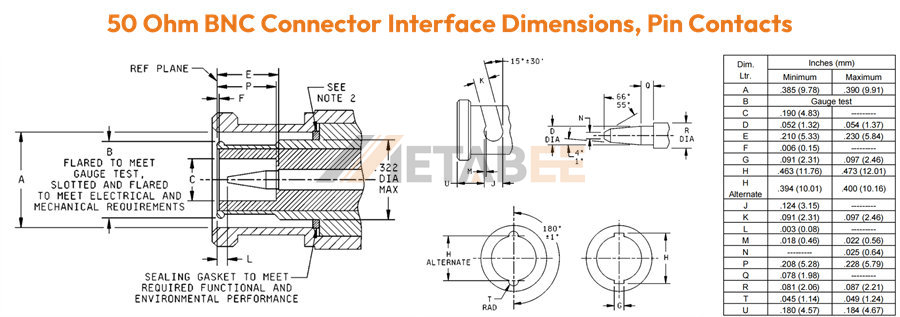
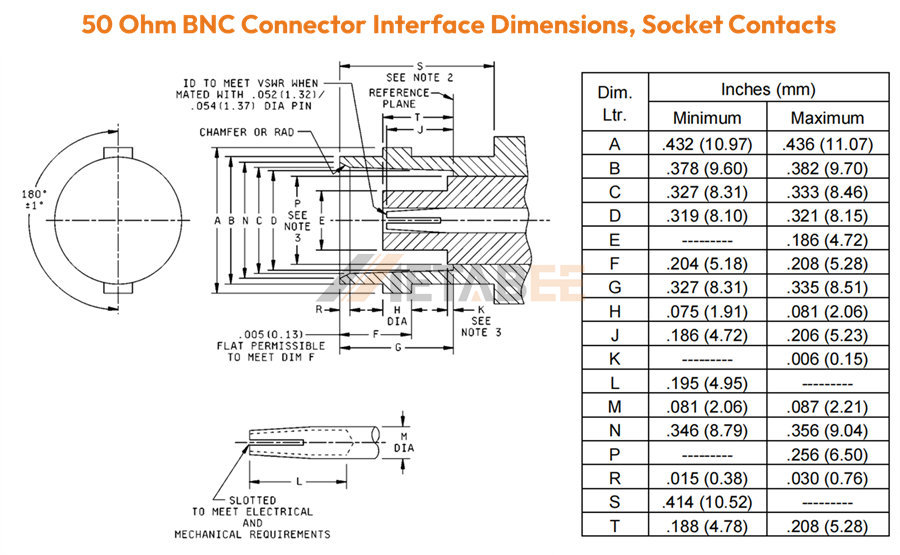
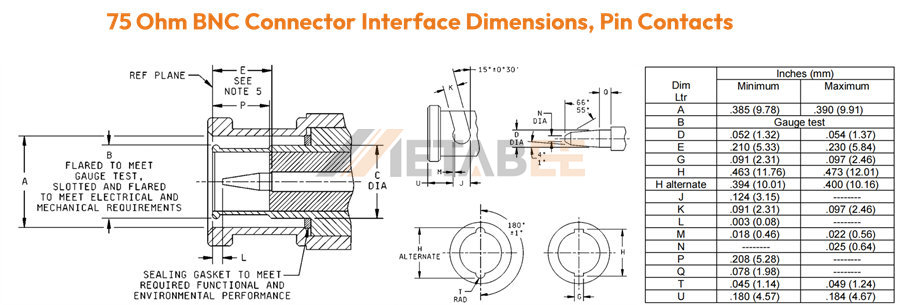
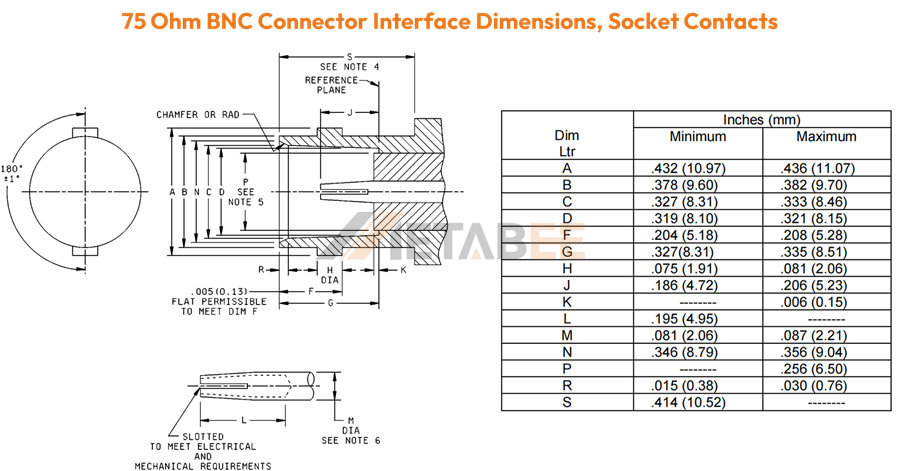
The MIL-DTL-348B standard precisely defines interface dimensions for both 50 Ohm and 75 Ohm BNC connectors.
50 Ohm BNC Male Connector Interface Dimensions
50 Ohm BNC Female Connector Interface Dimensions
75 Ohm BNC Male Connector Interface Dimensions
75 Ohm BNC Female Connector Interface Dimensions
9 Types of BNC Connectors You Need to Know
BNC connectors can be classified based on impedance, mounting style, orientation, and polarity, each designed for specific applications and installation requirements.
By Impedance
50 Ohm BNC Connectors
Primarily used in RF and telecommunications applications, including radio antennas, test equipment, and data communication systems. They offer optimal signal integrity for high-frequency transmissions.
75 Ohm BNC Connectors
Commonly found in video and broadcast applications, such as CCTV cameras, HD-SDI video systems, and cable TV networks. These connectors minimize signal loss in video transmission.

By Mounting Method
Cable-Type BNC Connectors
Designed for terminating coaxial cables, these connectors are further categorized by their attachment method:
- Solder-Type BNC: Requires soldering the center conductor and shield for a permanent connection. Often used in custom cable assemblies.
- Crimp-Type BNC: Uses a crimping tool to secure the connector onto the cable, providing a robust and reliable connection. Popular in field installations.
- Compression-Type BNC: Compresses the connector onto the cable for superior mechanical stability and weather resistance. Ideal for outdoor or harsh environments.
Panel-Mount BNC Connectors
Used for securing BNC connections to equipment panels or enclosures:
- Bulkhead-Mount BNC: Installed through a drilled hole in a panel, secured with a nut. Provides a stable connection point for equipment interfaces.
- Flange-Mount BNC: Features a flange for surface mounting, often used in rack-mounted systems or industrial control panels.
BNC PCB Connectors
Designed for direct integration with printed circuit boards (PCBs):
- Through-Hole BNC: Soldered into plated through-holes on the PCB, offering strong mechanical retention.
- Edge-Mount BNC: Mounted along the edge of a PCB, commonly used in modular test equipment.
- Surface-Mount (SMD) BNC: Soldered directly onto PCB pads, saving space in compact electronic designs.

By Orientation
- Straight BNC Connectors: The standard configuration where the connector aligns linearly with the cable or panel.
- Right-Angle BNC Connectors: Features a 90-degree bend, useful in tight spaces where cable routing requires a low-profile connection.
By Polarity
- Standard BNC Connectors: Follows conventional gender definitions—male connectors have a center pin, while female connectors have a socket.
- Reverse-Polarity BNC (RP-BNC) Connectors: Swaps the gender of the center contact (female center pin in male housing, or vice versa) for security in specialized applications.
How to Choose the Right BNC Connector
Selecting the appropriate BNC connector is critical for optimal system performance. Consider the following factors:
- Impedance Matching: Always match the connector's impedance (50Ω or 75Ω) to the characteristic impedance of your cable and equipment. Mismatching leads to signal reflections, which can cause significant signal loss and distortion.
- Frequency Requirements: While standard BNCs handle up to 4 GHz, if your application involves higher frequencies, investigate high-performance BNC variants or consider alternative connector types like SMA or N-Type.
- Cable Compatibility: Ensure the BNC connector is designed for the specific coaxial cable you are using (e.g., RG-58, RG-59). Different connectors are designed for different cable diameters and dielectric materials.
- Environmental Factors: For outdoor installations or harsh industrial environments, choose BNC connectors with appropriate ingress protection (IP) ratings and robust construction materials to withstand moisture, dust, and temperature extremes.
Top BNC Connector Manufacturers
Several reputable manufacturers produce high-quality BNC connectors, offering a wide range of options for various applications:
METABEE offers a comprehensive range of high-quality BNC connectors and other RF connector solutions. Our product portfolio includes standard and specialized variants to meet diverse application requirements. Beyond off-the-shelf options, we provide custom RF connector and cable harness solutions tailored to your specific technical specifications and performance needs. For detailed product information or custom project inquiries, our engineering team is ready to assist you. Contact us today to discuss your connectivity requirements.

Related Products
Conclusion
In summary, a BNC connector is a versatile and indispensable coaxial RF connector, recognized by its distinctive bayonet locking mechanism. Its ability to provide secure, quick-connect/disconnect functionality, combined with excellent impedance control and shielding, has cemented its place in a vast array of applications, from critical broadcast infrastructure to everyday test benches. Whether for video signals, radio communications, or precision measurements, understanding the types, specifications, and proper use of BNC connectors is key to ensuring reliable signal transmission.
Looking for high-quality BNC connectors? Browse our selection from top manufacturers today and find the perfect solution for your electronic and RF needs!
