
In the rapidly evolving world of telecommunications and industrial automation, connectivity is not just a detail—it is the lifeline of the entire system. Whether you are engineering a 5G base station that must withstand a decade of storms or designing a high-precision rotary encoder for a factory floor, the choice of connector defines the reliability of your product.
Among the myriad of interface options available, the M16 connector stands out as a legendary workhorse. It is robust, compact, and serves as the backbone for one of the most critical standards in the wireless industry: AISG.
If you are a procurement manager, electrical engineer, or telecom infrastructure installer, this guide is for you. We will dive deep into what M16 connectors are, their critical relationship with AISG standards, their technical specifications, and how to select the right one for your application.
Introduction
Imagine a cellular tower mounted 50 meters above the ground, exposed to driving rain, freezing snow, and blistering heat. Inside the complex ecosystem of antennas and amplifiers, data and power must flow without interruption. If a connector fails here, the cost isn't just a replacement part—it involves expensive tower climbs, network downtime, and frustrated subscribers.
This is the environment where the M16 connector thrives.
Originally designed as a robust solution for audio and instrumentation, the M16 circular connector has evolved into a global standard for harsh environments. Its metric threaded locking mechanism provides vibration resistance that push-pull connectors simply cannot match. Today, it is best known as the physical interface for AISG (Antenna Interface Standards Group) applications, playing a pivotal role in the global rollout of 4G and 5G networks.
In this comprehensive guide, we will explore:
- The definition and origins of the M16 connector.
- Why it is the preferred choice for AISG and RET applications.
- A detailed breakdown of types, pinouts, color codes and termination methods.
- Key technical parameters like IP67 ratings and shielding.
- A practical buyer’s guide to choosing the right connector.
What is an M16 Connector? The Definition
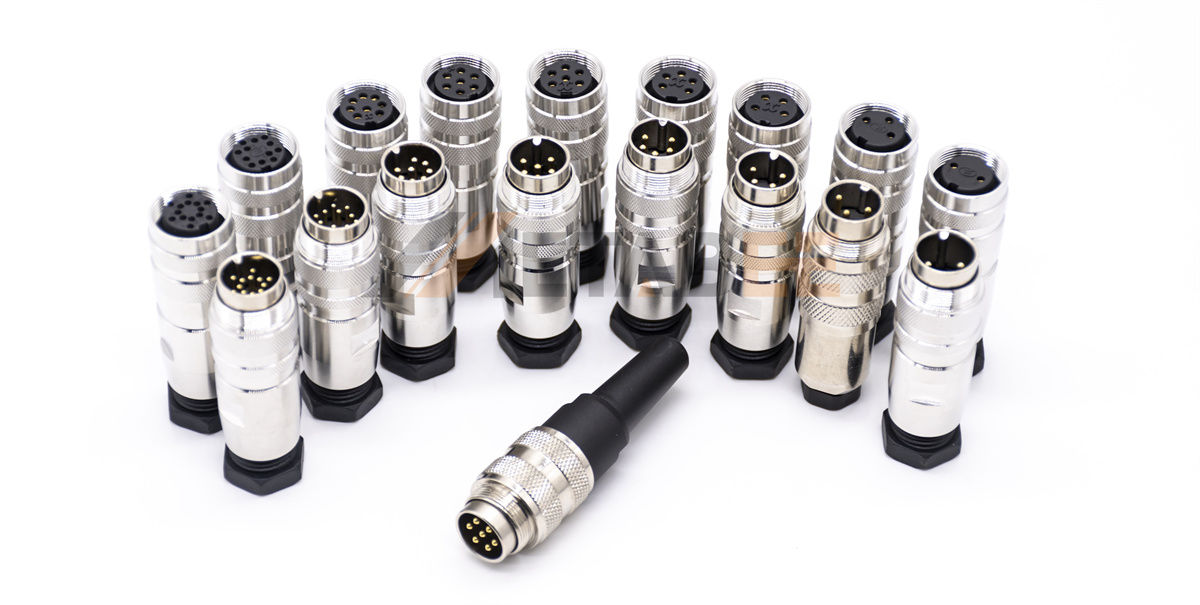
At its core, an M16 connector is a circular connector featuring a locking thread with a nominal diameter of 16 millimeters. While "M16" refers specifically to the thread size, the connector itself is defined by a combination of rugged mechanical design and versatile electrical configurations.
Origin and Standardization
The M16 connector traces its lineage back to the German DIN standards (Deutsches Institut für Normung). It was originally standardized under DIN 41524 and related specifications for audio and data transmission. Over time, as the need for ruggedized versions of these connectors grew—particularly for industrial and outdoor use—the standard evolved into what is now covered by IEC 61076-2-106.
This standardization is crucial for procurement. It means that an M16 connector manufactured by a top brand is intermateable with a compliant connector from other high-quality manufacturers. However, this requires that they adhere to the same pin configuration and coding.
Key Characteristics
Why do engineers continue to choose M16 over newer, smaller interfaces like M8 or M12?
- High Pin Density in a Compact Shell: While M12 connectors typically max out at 12 or 17 pins (with very fragile contacts), M16 connectors can comfortably house up to 24 contacts in a relatively small footprint, while maintaining robust contact durability.
- Threaded Locking Mechanism: The screw-locking system ensures that the connector cannot be accidentally unplugged. More importantly, it provides the compression force necessary to compress the O-rings, creating a watertight seal.
- Robust EMI Shielding: The metal housing of M16 connectors allows for excellent 360-degree electromagnetic interference (EMI) shielding. This is a non-negotiable requirement for data integrity in electrically noisy environments like cell towers or factory floors.
The Connection Between M16 and AISG
For many professionals in the telecommunications sector, "M16 connector" and "AISG connector" are virtually synonymous. However, understanding the distinction and the relationship between the two is vital.
What is AISG?
AISG stands for the Antenna Interface Standards Group. It is a non-profit consortium of telecommunications companies that creates standards for the control and monitoring of Antenna Line Devices (ALDs).
In modern cellular networks, operators need to adjust the tilt of their antennas to optimize coverage and reduce interference. Decades ago, this required a technician to climb the tower and mechanically adjust the antenna. Today, this is done remotely via RET (Remote Electrical Tilt) systems. The protocol that allows the base station to "talk" to the antenna motor is the AISG protocol (specifically AISG 2.0 or the newer AISG 3.0).
The Role of the M16 Connector in AISG
The AISG standard specifies not just the communication protocol (RS-485), but also the physical interface.
- The Standard Interface: The AISG C485 standard explicitly specifies the use of 8-pin circular connectors based on the IEC 60130-9 standard (which falls under the M16/DIN family).
- Why M16? The group chose this connector because it offers the perfect balance of ruggedness (IP67), sufficient pin count (8 pins), and current carrying capacity (to power the motors in the RET units).
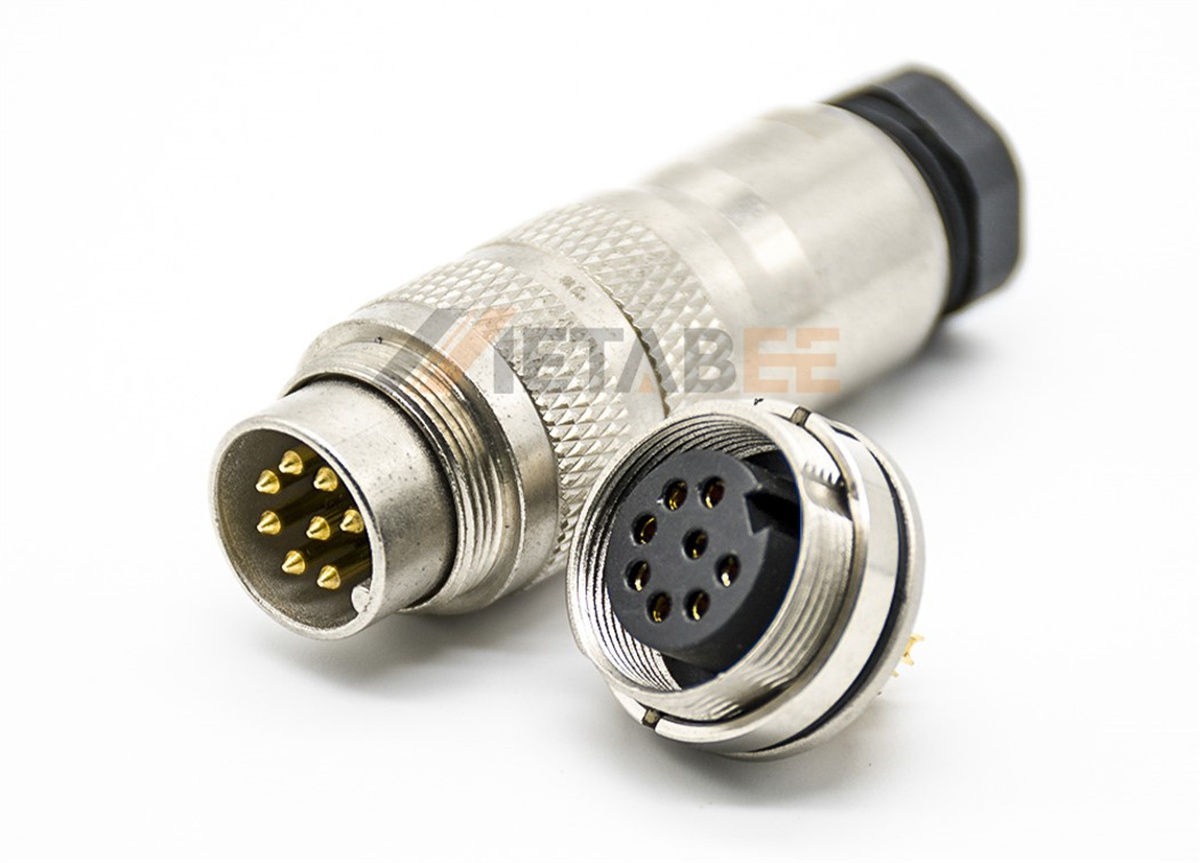
M16 8-Pin AISG Connector
The AISG Pinout Configuration
If you are sourcing M16 connectors for telecom use, you are almost certainly looking for the 8-pin version.
- Pin 1: +12V DC (Power supply for the motor)
- Pin 2: Not connected (reserved)
- Pin 3: RS-485 B (Data signal)
- Pin 4: RS-485 GND (Data ground)
- Pin 5: RS-485 A (Data signal)
- Pin 6: 10V - 30V DC (Power)
- Pin 7: DC Return (Power ground)
- Pin 8: Not connected
Note: While 8-pin is the standard, the M16 shell size allows for variations. Always verify if your specific application adheres strictly to AISG 2.0 or if it uses a proprietary configuration.
M16 Connector Pinout
Before selecting a connector body style, it is crucial to understand the internal wiring standards. The M16 series is versatile, but this versatility means engineers must be vigilant about Pinouts (contact arrangements) and Color Codes (wire identification) to prevent miswiring.
Understanding the Pinout Configuration
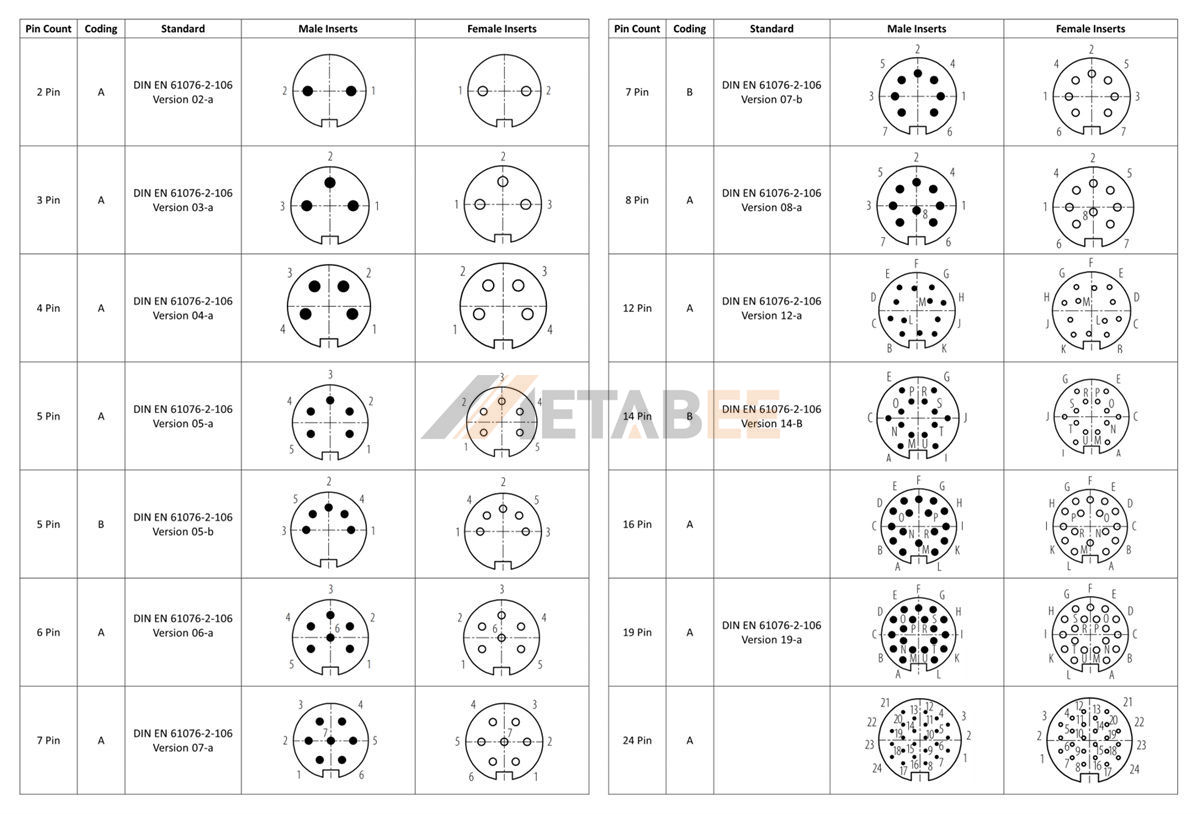
The "Pinout" refers to the specific arrangement of the contacts within the connector insulator. For M16 connectors, these arrangements typically follow DIN standards.
- 3 to 5 Pins: Designed for power. Pins are spaced further apart to prevent arcing at higher voltages.
- 6 to 8 Pins: The standard for signal transmission. The 8-pin DIN layout (DIN 45326) is the most critical for your AISG applications, featuring a circular arrangement of pins 1-7 with pin 8 in the center.
- 12 to 24 Pins: High-density layouts for data. Pins are much thinner and packed closely. Warning: These are difficult to solder by hand; crimp contacts or pre-molded cables are recommended.
Types of M16 Connectors
M16 connectors are highly versatile. To order the correct part, you need to understand the four main dimensions of classification.
By Mounting Type
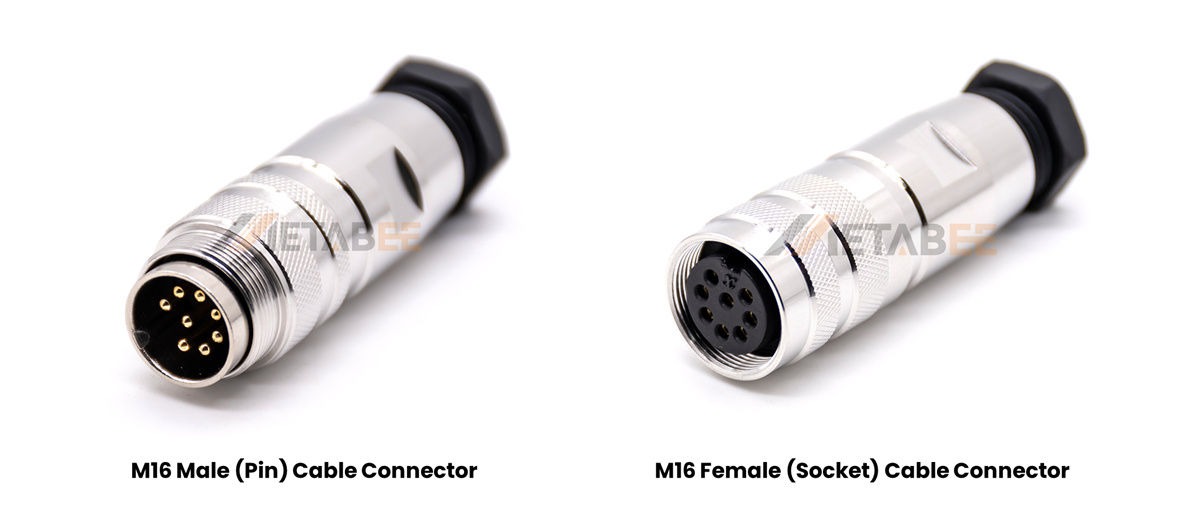
Cable Connectors (Plugs/Sockets): These are attached to the end of a cable.
- Male (Pin) Cable Connector: Typically has the external threads.
- Female (Socket) Cable Connector: Typically has the coupling nut.
Use Case: Creating double-ended RET control cables.
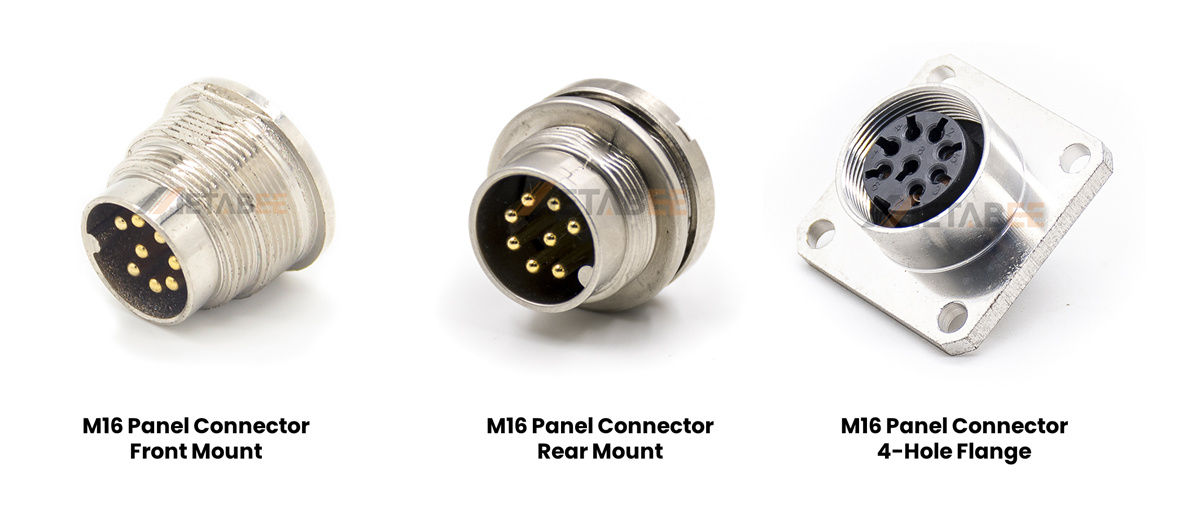
Panel Mount Receptacles: These are mounted onto the device housing (e.g., the base station radio unit or the antenna body).
- Front Mount: Installed from the outside of the panel.
- Rear Mount: Installed from the inside of the panel (often offers better water sealing integration).
- Flange vs. Nut: Some use a square flange with 4 screw holes, while others use a single central locking nut.
By Body Shape
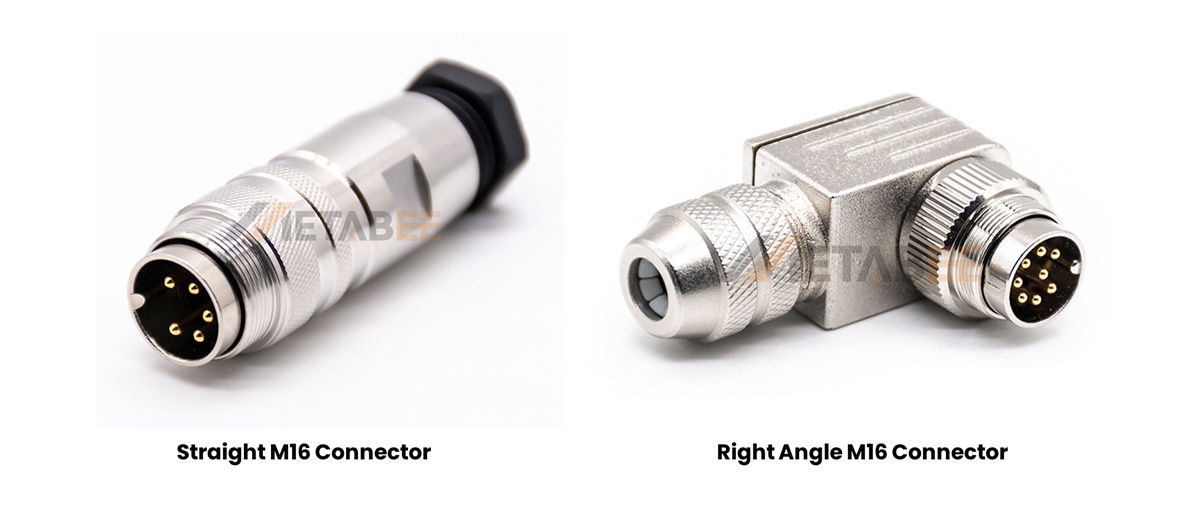
- Straight: The standard configuration. Best for general use where cable routing is straightforward.
- Right-Angle: The cable exits at 90 degrees. Why use it? Essential for tight spaces where a straight cable would be bent too sharply, potentially damaging the wires or the connector seal.
By Termination Method
How you attach the wires to the connector contacts matters for production volume and field repair.
- Solder Termination for Cable: The most common method. Wires are soldered into cups on the rear of the contacts. It provides a solid, permanent connection but requires skilled labor.
- Screw Termination for Cable: Wires are clamped down by small screws. These connectors are Perfect for field installation or repairs where no soldering iron is available.
- Through Hole for PCB Mount: Designed for direct integration into a device's electronics. The connector features "dip solder" pins (straight or right-angled) that pass through holes in a Printed Circuit Board (PCB).
By Pin Count
While 8-pin is the king of AISG, M16 connectors are available in:
- 3 to 5 pins: High current applications.
- 6 to 8 pins: Standard signal and power (AISG uses 8).
- 12, 14, 16, 19, 24 pins: High-density signal transmission for sensors and instrumentation.
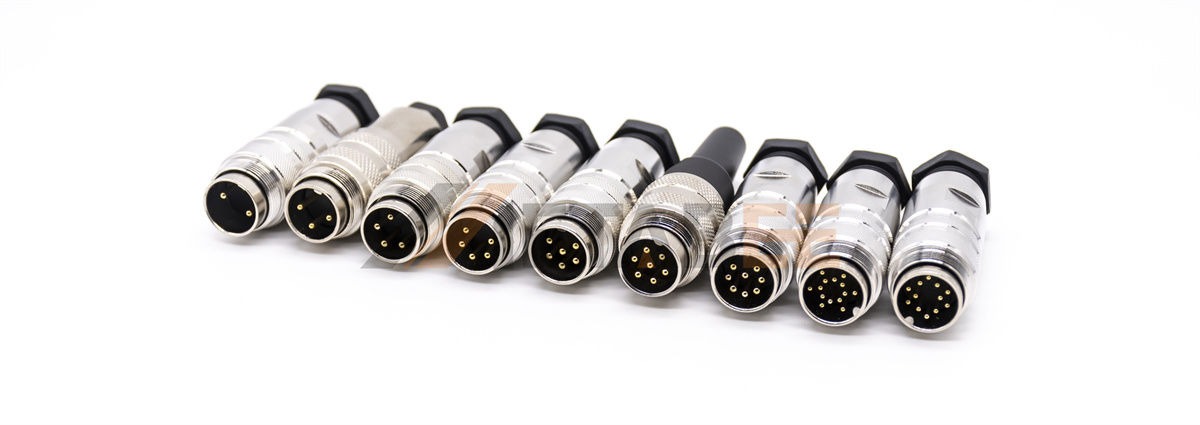
Metabee provides various types of M16 connectors. If you need help selecting the right one, feel free to reach out to our technical team.
Key Technical Parameters (Specifications)
When reading a datasheet for an M16 connector, specific parameters dictate whether the component will survive in your application.
Environmental Protection (IP Rating)
For outdoor telecom and industrial use, IP67 is the benchmark.
- IP6x (Dust Tight): No ingress of dust; complete protection against contact.
- IPx7 (Temporary Immersion): The connector can be submerged in 1 meter of water for 30 minutes without harmful water ingress.
Note: This rating usually applies only when the connector is mated (plugged in) and locked. For unmated connectors on a tower, a protective cap is mandatory to maintain the IP rating.
Electrical Specifications
Rated Voltage: Typically ranges from 60V to 250V depending on pin density.
- 60V for 5/6/7/8/12/14/19/24 pin;
- 250V for 2/3/4/5 Pin.
Rated Current:
- 7A for 2/3 pin;
- 6A for 4/5 pin;
- 5A for 6/7/8 pin;
- 3A for 12/14/19 pin;
- 1A for 24 pin.
Shielding :
The connector housing is usually made of Nickel-Plated Brass. This metal shell connects to the cable shield, creating a Faraday cage around the connection. This prevents the high-frequency RF signals from the antennas from interfering with the sensitive control data in the AISG cable.
Materials
- Housing: Die-cast zinc or brass with nickel plating (for EMI shielding and ruggedness).
- Contacts: Copper alloy with Gold Plating. Gold is essential because it resists oxidation. Even a microscopic layer of oxide can interrupt the low-voltage data signals used in RS-485 communications.
- Insulator: Typically PBT or PA66 (Polyamide), offering high insulation resistance and flame retardancy (UL94 V-0).
Major Applications of M16 Connectors
While we have focused heavily on AISG, the M16's versatility sees it deployed across various sectors.
Telecommunications (The Primary Driver)
This is the largest market for M16 connectors today.
- Base Transceiver Stations (BTS): Connecting the base station to the Tower Mounted Amplifiers (TMA).
- Remote Electrical Tilt (RET) Systems: The cable assembly (typically an M16 Male to M16 Female) carries power and data to tilt the antenna.
- GPS Receivers: On communication towers.
Industrial Automation
- Rotary Encoders: M16 connectors are a standard interface for heavy-duty encoders used in conveyor belts and robotic arms.
- Sensors and Actuators: Where M12 connectors are too small or lack the necessary pin count, M16 steps in.
Measurement and Instrumentation
Data Acquisition Systems: In outdoor monitoring stations (e.g., weather stations, seismic monitors), M16 connectors provide the necessary weatherproofing for sensitive sensor data.
Professional Audio (Legacy)
While XLR is the standard for stage audio, M16 (DIN) derivatives are still found in legacy microphone systems and specialized broadcast equipment requiring multi-pin connections.
How to Choose the Right M16 Connector?
Sourcing the wrong connector can lead to costly assembly failures. Use this 4-step checklist before you order.
Step 1: Pin Count and Layout
Don't just count the holes. Check the layout.
- Is it a standard DIN layout?
- For AISG, is it the standard 8-pin configuration (DIN 45326)?
Step 2: Cable Diameter (Cable Gland Range)
This is the most common mistake. The back of the connector has a cable gland (strain relief).
If your cable is 6mm thick, but the connector gland is designed for 8-10mm, the seal will not be watertight (IP67 failed).
If the cable is too thick, you cannot assemble it.
Action: Measure your cable jacket diameter precisely and choose the matching clamping range (e.g., 4-6mm, 6-8mm).
Step 3: Environmental Exposure
- Indoor/Clean: Standard IP40 might suffice (rare for M16).
- Outdoor/Industrial: Must specify IP67.
- Corrosive Environment (Marine/Chemical): Consider Stainless Steel housing instead of Nickel-Plated Brass to prevent salt spray corrosion.
Step 4: Termination Style
- Are you making 50 cables by hand? Solder is fine.
- Are you making 10,000 cables in a factory? Crimp contacts are necessary for speed and consistency.
- Are you repairing a cable 50 meters up a tower? Screw termination is a lifesaver.
Still not sure which M16 connector to choose? Contact us today.
Conclusion
The M16 connector is a testament to the "if it isn't broken, don't fix it" philosophy. Despite being based on established DIN standards, it has adapted perfectly to the modern demands of the 5G era.
For telecommunications professionals, the M16 is the gateway to AISG compliance, ensuring that complex antenna systems operate seamlessly. For industrial engineers, it offers a robust, shielded, and high-density interface that survives where plastic connectors fail.
When choosing an M16 connector, quality materials (gold plating, robust metal shells) and precise manufacturing tolerances are non-negotiable. A cheap connector can compromise an expensive system.
Are you looking for high-performance, AISG-compatible M16 connectors for your next project?
Whether you need a custom cable assembly for a 5G rollout or a rugged panel mount solution for industrial sensors, choosing the right partner is key. Ensure your supplier provides full datasheets, IP67 certification, and compatibility guarantees.
Related Products
Frequently Asked Questions (FAQ)
Q: Are all M16 connectors waterproof?
A: No. While most M16 connectors designed for industrial use are rated IP67 or IP68, this is not automatic. You must check the datasheet. Furthermore, the IP rating is usually only valid when the connector is fully mated and locked, or covered with a protective cap.
Q: What is the difference between M12 and M16 connectors?
A: The primary difference is size and pin capacity. M12 connectors use a 12mm locking thread and generally support fewer pins (typically up to 12, rarely 17) with lower current ratings. M16 connectors use a 16mm thread, are physically larger, more robust, and can support up to 24 pins. M16 is preferred when higher robustness or higher pin counts are needed.
Q: Can I use a standard DIN connector for AISG applications?
A: It depends. AISG connectors are based on the DIN 45326 standard (8-pin). However, a "standard" consumer-grade DIN connector found in an audio shop will lack the IP67 waterproofing, EMI shielding, and current-carrying capacity required for outdoor RET antenna systems. Always specifically specify "AISG compliant" or industrial-grade M16 connectors.
Q: What does "AISG C485" mean?
A: AISG C485 refers to the standard developed by the Antenna Interface Standards Group for the physical layer of the interface. It specifies the use of RS-485 signaling over a specific connector type (the M16/DIN 8-pin) to control antenna line devices.
