
In the intricate world of RF systems, the unsung heroes ensuring seamless connectivity are the RF connectors. Among the myriad of options available, the BNC and TNC connectors stand out as workhorses with distinct characteristics and application niches. Understanding the differences between BNC and TNC connectors is crucial for engineers, technicians, and anyone involved in industries ranging from telecommunications and aerospace to networking and test and measurement.
This comprehensive guide delves deep into the origins, key differences, and typical applications of BNC and TNC connectors. Whether you're designing a cutting-edge communication system or maintaining legacy equipment, this article will provide the insights you need to make informed decisions about connector selection.
What are BNC and TNC Connectors?
Both the BNC and TNC connectors have a rich history rooted in the mid-20th century, a testament to their robust and reliable designs. While they share a common ancestor, their evolution has led to distinct advantages in various scenarios.
BNC Connector
The BNC connector is instantly recognizable by its bayonet coupling mechanism. It features two opposing bayonet lugs on the female connector that mate with corresponding slots and a locking ring on the male connector. This design allows for a quick connect and disconnect, making it particularly convenient in applications where frequent reconnections are necessary.
Historically, BNC connectors have been widely adopted in video signal transmission, test and measurement equipment, and older networking systems. Their ease of use and relatively low cost contributed to their widespread popularity and established them as a legacy connector in many fields.

TNC Connector
The TNC connector, on the other hand, employs a threaded coupling mechanism. This screw-on design provides a more secure and vibration-resistant connection compared to BNC connectors. The threads ensure consistent contact and shielding, making TNC connectors suitable for higher frequency applications and environments prone to mechanical stress.
The TNC connector can be viewed as a threaded upgrade to the BNC. It was developed to address the limitations of the bayonet coupling in certain high-performance scenarios, offering improved electrical performance and mechanical stability.

Shared Origin
It's important to note that both the BNC and TNC connectors are derivations of the earlier N-type connector, which was one of the first RF connectors developed for high-frequency applications. The "Neill" in both names refers to Paul Neill of Bell Labs, one of the inventors of the N-type connector. The "Concelman" refers to Carl Concelman of Amphenol, who was also instrumental in their development. The BNC was conceived as a smaller, quick-connect alternative to the N-type, while the TNC retained the size and performance aspects of the N-type but incorporated the more convenient and secure threaded coupling.
BNC vs TNC Connectors: Detailed Comparison
To effectively differentiate between BNC and TNC connectors, a detailed comparison across several key parameters is essential:
Shared Origin
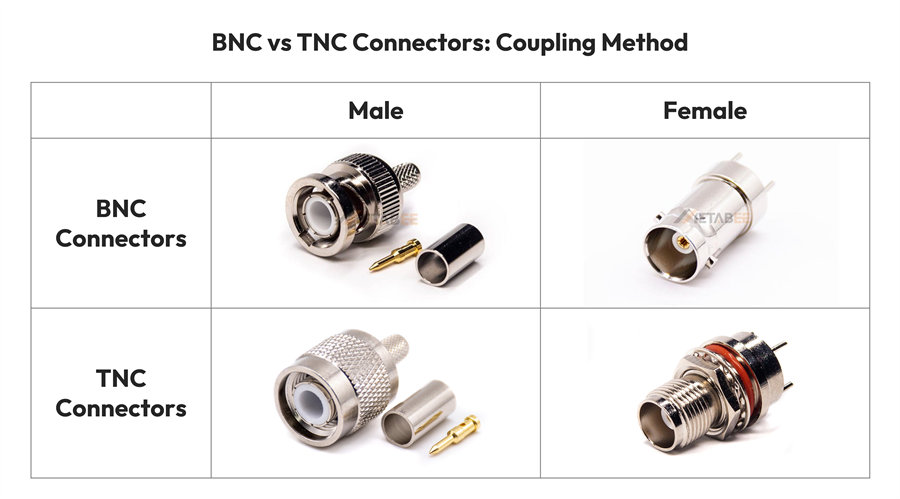
- BNC Connectors: Utilizes a bayonet coupling system. A simple push and twist (typically a quarter turn) engages and locks the connector. This offers speed and ease of use, especially in environments requiring frequent connections and disconnections. However, it can be less secure under significant vibration or stress.
- TNC Connectors: Employs a threaded coupling mechanism. The connectors are secured by screwing them together. This provides a robust and reliable connection that is significantly more resistant to vibration and accidental disconnection, making it ideal for demanding applications.
Frequency Range
The electrical performance of BNC and TNC connectors is similar, with their most significant difference lying in the frequency range.
- BNC connectors are generally specified for frequencies up to 4 GHz. Their design inherently limits their high-frequency capabilities due to potential signal leakage and impedance mismatches at the bayonet interface.
- TNC connectors are designed for higher frequency operation, typically up to 11 GHz. The threaded connection ensures better electrical continuity and shielding, allowing for cleaner signal transmission at these elevated frequencies. High-performance TNC variants can even reach up to 18 GHz.
Materials & Durability
BNC and TNC connectors share nearly identical materials and durability characteristics.
Shell Materials and Finish
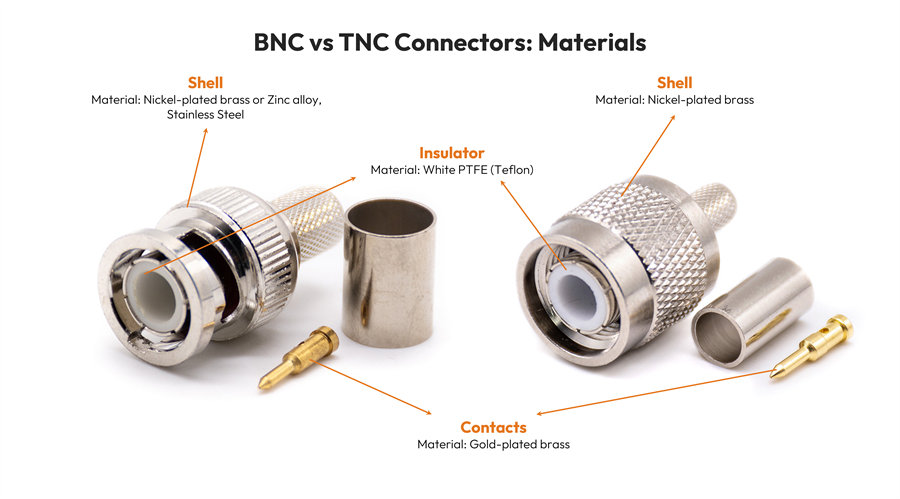
Typically, both TNC connectors employ brass housings with nickel plating. While BNC connectors also primarily use brass housings with nickel plating, some variants utilize zinc alloy as the housing material. Regarding surface finishes, in addition to standard nickel plating, certain BNC connectors may feature gold plating.
Contact and Insulator
The contact components and insulators of BNC and TNC connectors are made of identical materials. The contacts are constructed from nickel-plated brass, while the insulators utilize white Teflon (PTFE) material.
Price & Applications
BNC Connectors: Generally more affordable than TNC connectors due to their simpler construction and more common materials. They find widespread use in:
- CCTV systems: For video signal transmission.
- Test and measurement equipment: Oscilloscopes, signal generators, etc.
- Legacy networking equipment: Though less common now.
- Educational and laboratory setups.
TNC Connectors: Typically command a premium price due to their more robust construction and superior high-frequency performance. Their applications include:
- Military and aerospace communication systems.
- 5G and other advanced wireless technologies.
- Radar systems.
- Satellite communication equipment.
- High-frequency test and measurement instruments.
- Applications requiring resistance to vibration and harsh environments.
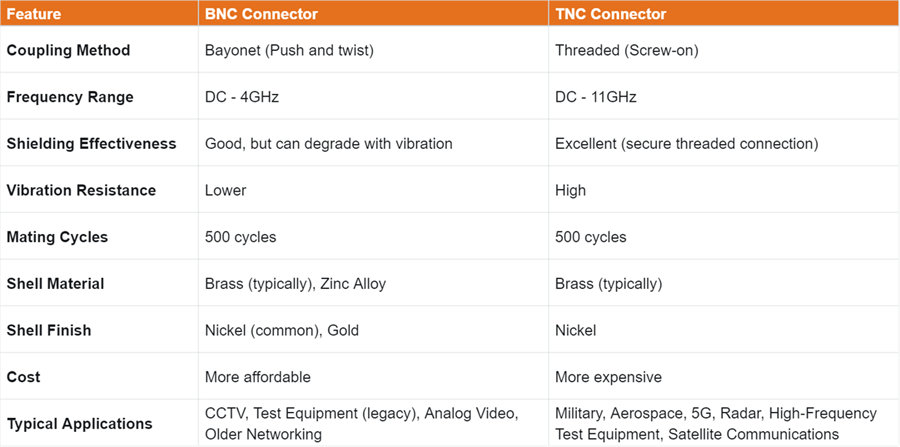
The table below provides a detailed comparison of BNC and TNC connector specifications for your reference:
Related Products
Conclusion
For BNC and TNC connectors, there is no single "better" option. The ideal choice depends entirely on the specific requirements of the application.
BNC connectors remain a valuable and widely used option for applications prioritizing quick connection and disconnection, cost-effectiveness, and operation at frequencies below 4 GHz. They are a staple in video systems, many test and measurement setups, and legacy equipment.
TNC connectors are the preferred choice when high-frequency performance (up to 11 GHz and beyond), resistance to vibration and mechanical stress, and robust durability are paramount. Their secure threaded coupling makes them essential in demanding environments such as military, aerospace, and advanced wireless communication systems.
Ultimately, when selecting between a BNC and a TNC connector, carefully consider the following factors:
- Operating frequency range: Ensure the connector can handle the required frequencies.
- Environmental conditions: Consider vibration, temperature, and potential for moisture exposure.
- Mechanical requirements: Evaluate the need for secure connections and frequent mating cycles.
- Impedance matching: Always match the connector impedance to the system's impedance.
- Budget: While TNC connectors generally cost more, their performance and durability may justify the investment in demanding applications.
By understanding the key differences of BNC and TNC connectors, you can make informed decisions that ensure optimal performance and reliability in your RF and coaxial systems.
FAQs
Q: Can I connect a BNC to a TNC connector?
A: Yes, you can connect a BNC to a TNC connector using an appropriate adapter or cable. However, it is crucial to ensure that the impedance of the connected components matches (e.g., 50Ω to 50Ω or 75Ω to 75Ω) to avoid signal loss and reflections.
Q: Which is better for Wi-Fi: BNC or TNC?
A: TNC connectors are generally better for Wi-Fi applications. Wi-Fi often operates at frequencies above the typical 4 GHz limit of standard BNC connectors (e.g., 2.4 GHz, 5 GHz, and 6 GHz bands). TNC connectors, with their higher frequency handling capabilities (up to 11 GHz and beyond), provide better performance and signal integrity for Wi-Fi systems.
Q: Are BNC and TNC connectors interchangeable?
A: No, BNC and TNC connectors are not directly interchangeable due to their different coupling mechanisms. BNC uses a bayonet locking system, while TNC uses a threaded coupling. They require different mating interfaces.
Q: Why choose 75Ω over 50Ω?
A: 75Ω impedance is primarily chosen for video signal transmission to minimize signal reflections and ensure optimal video quality. 50Ω impedance is the standard for most RF power transmission and general-purpose RF signal applications. The choice depends entirely on the type of signal being transmitted. METABEE provides both 50 and 75 Ohm BNC / TNC connectors.
Q: Does TNC handle more power than BNC?
A: Generally, yes. TNC connectors can often handle more power than standard BNC connectors. This is partly due to their more secure and robust threaded connection, which provides better electrical contact and heat dissipation, especially at higher frequencies and power levels.
Q: Is BNC obsolete?
A: No, BNC connectors are not obsolete. They remain widely used in various applications, particularly in video surveillance (CCTV), test and measurement equipment, and some legacy systems where their quick-connect capability and lower cost are advantageous.
Q: Can TNC connectors be used outdoors?
A: Yes, TNC connectors can be used outdoors, especially waterproof variants that are designed to withstand moisture, dust, and other environmental factors. Their robust construction also makes them suitable for outdoor applications where vibration or mechanical stress might be a concern.
Q: What’s the max frequency for BNC and TNC connectors?
A: The maximum usable frequency for standard BNC connectors is typically around 4 GHz. While some variations might operate slightly above this, performance degradation can occur. TNC connectors, in contrast, can reliably operate up to 11 GHz, with high-performance versions reaching even higher frequencies.
Q: Are there mini versions of BNC/TNC?
A: Yes, there are miniature versions of both BNC and TNC connectors, Mini-BNC and Mini-TNC connectors. These compact variants are designed for use in smaller electronic devices and applications where space is limited while still providing the basic characteristics of their standard-sized counterparts. If you want to learn more about mini BNC and TNC connectors, you can contact our support team.
If you have any questions about this article or our products, please don’t hesitate to contact us. Alternatively, you can email us at [email protected].
