
In the demanding worlds of aerospace, defense, and heavy industry, reliable electrical connections aren't just a convenience—they're a necessity. The integrity of mission-critical systems often hinges on the performance of a single component: the connector. Among the vast array of military-standard (MIL-spec) connectors, two series frequently stand out for their widespread use and robust design: MIL-DTL-5015 and MIL-DTL-38999.
While both are built to withstand harsh conditions, they were designed for different eras and different sets of challenges. Understanding their distinctions is crucial for anyone involved in design, procurement, or maintenance. This article will delve into a clear comparison of MIL-DTL-5015 vs MIL-DTL-38999 to help you make informed decisions for your specific application.
What are MIL-DTL-5015 Connectors?
The MIL-DTL-5015 standard, originally released as MIL-C-5015, is a true workhorse in the world of circular connectors. It dates back to the mid-20th century, making it one of the oldest and most widely adopted military connector specifications. Its longevity speaks volumes about its effectiveness and reliability in numerous applications.

Key Features & Advantages
- Simple, Robust Design: The hallmark of the 5015 series is its straightforward threaded coupling mechanism. This design makes it incredibly rugged and relatively easy to mate and unmate, even in challenging field conditions.
- Good Vibration Resistance: For many industrial and ground-based applications, the 5015 offers adequate vibration resistance, ensuring stable connections.
- Broad Temperature Range: These connectors are designed to operate effectively across a respectable range of temperatures, typically -55℃ to +125℃. It makes them versatile for various environments.
- Ease of Termination and Field Repair: Thanks to their simpler design, MIL-DTL-5015 connectors are generally easier to terminate in the field and repair if damage occurs, which is a significant advantage for maintenance teams.
- Cost-Effectiveness: Due to their long history, high production volumes, and less complex manufacturing, 5015 connectors are often a more economical choice.
- Wide Availability: They are manufactured by numerous companies worldwide, ensuring excellent availability of components and replacements. METABEE is one of the most reliable manufacturers from China.
Limitations
Despite their strengths, MIL-DTL-5015 connectors do have limitations, particularly when compared to newer, more advanced standards:
- Limited Sealing Capabilities: While they offer good environmental protection against dust and splashes, they generally lack the advanced sealing features needed for prolonged fluid immersion or highly corrosive environments. Their IP rating is typically IP67.
- Basic EMI/RFI Shielding: While some variations offer basic shielding, they aren't designed for the rigorous electromagnetic interference (EMI) and radio frequency interference (RFI) protection often required in sensitive electronic systems.
- Less Suited for Extreme Vibration: For applications experiencing extreme, prolonged vibration, the threaded coupling might eventually loosen without proper lockwiring or anti-vibration measures.
- Lower Pin Densities: Compared to modern connectors, 5015s typically offer lower contact densities, meaning you need a larger connector to accommodate the same number of circuits.
Typical Applications
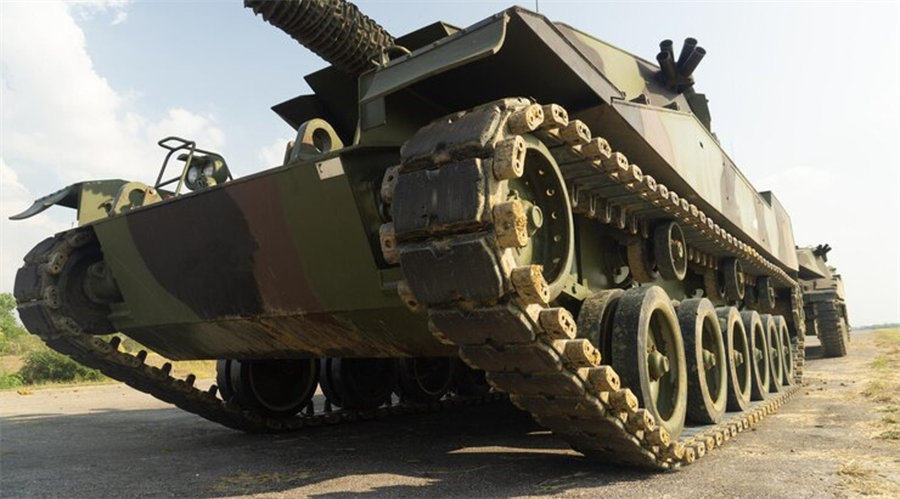
MIL-DTL-5015 connectors are still widely used in industrial machinery, ground support equipment, older aerospace systems, factory automation, and commercial vehicle applications where a robust, cost-effective, and easily serviceable connector is paramount.
What are MIL-DTL-D38999 Connectors?
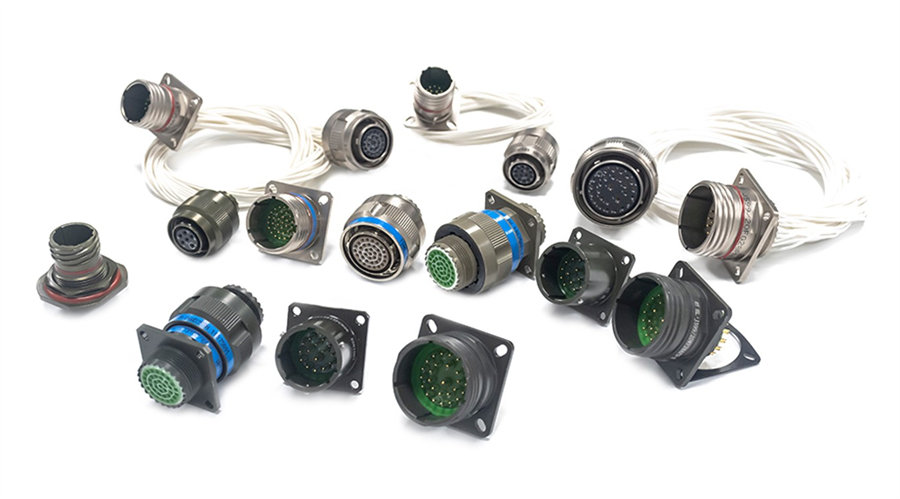
Stepping into the realm of high-performance connectors, we find the MIL-DTL-38999 series. Developed much later than the 5015, the 38999 standard (originally MIL-C-38999) was designed to meet the increasingly stringent demands of modern military and aerospace applications. It represents the pinnacle of military circular connector technology, prioritizing ultimate reliability and performance in the most challenging environments imaginable.
Key Features & Advantages
Superior Environmental Sealing: This is a hallmark of the 38999 series. Many variants are designed for hermetic sealing, offering exceptional resistance to moisture, fuels, hydraulic fluids, and other contaminants. They can withstand prolonged immersion without compromising integrity.
Advanced EMI/RFI Shielding: MIL-DTL-38999 connectors often feature integral shielding mechanisms, providing superior protection against electromagnetic and radio frequency interference, critical for sensitive electronic systems.
High Vibration & Shock Resistance: Engineered for extreme dynamic environments, these connectors excel in applications subjected to severe vibration and mechanical shock, maintaining electrical continuity even under duress.
Higher Pin Densities: 38999 connectors offer significantly higher contact densities, allowing more signals and power to be routed through a smaller, lighter package—a critical advantage in space-constrained applications.
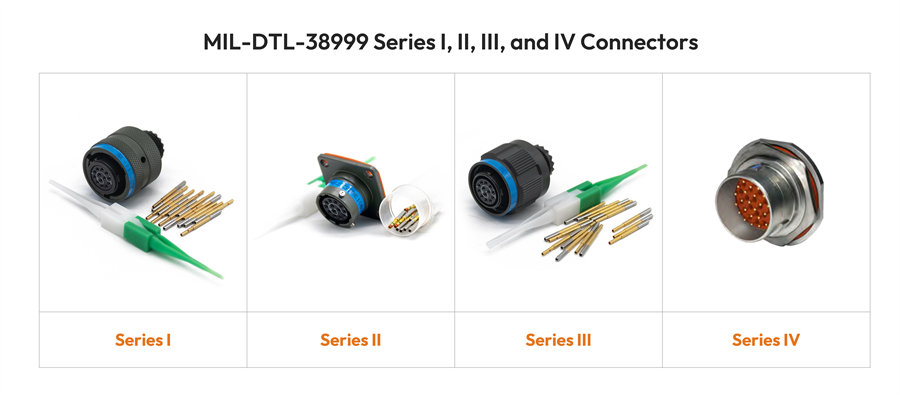
Variety of Coupling Mechanisms: The standard encompasses four main series (I, II, III, IV), each featuring different coupling styles:
- Series I: Bayonet coupling, often used for quick connections.
- Series II: Smaller bayonet coupling, lower profile.
- Series III: Threaded coupling, known for excellent vibration resistance.
- Series IV: Breech-lock coupling, providing quick connect/disconnect with high shock resistance.
Diverse Shell Materials & Finishes: Available in materials like aluminum, stainless steel, and composite, with various platings (e.g., cadmium, nickel, zinc-nickel) to ensure optimal corrosion resistance for specific environments.
Scoop-Proof Designs: A common feature, especially in Series III and IV, is the scoop-proof design, which prevents accidental damage to the contacts during mating, even if misaligned.
Limitations
The advanced capabilities of MIL-DTL-38999 come with some trade-offs:
- Higher Cost: Their complex design, advanced materials, and stringent manufacturing processes make them significantly more expensive than 5015 connectors.
- More Complex Termination: Installing and repairing 38999 connectors often requires specialized tools and trained personnel, making field repairs more involved.
Typical Applications
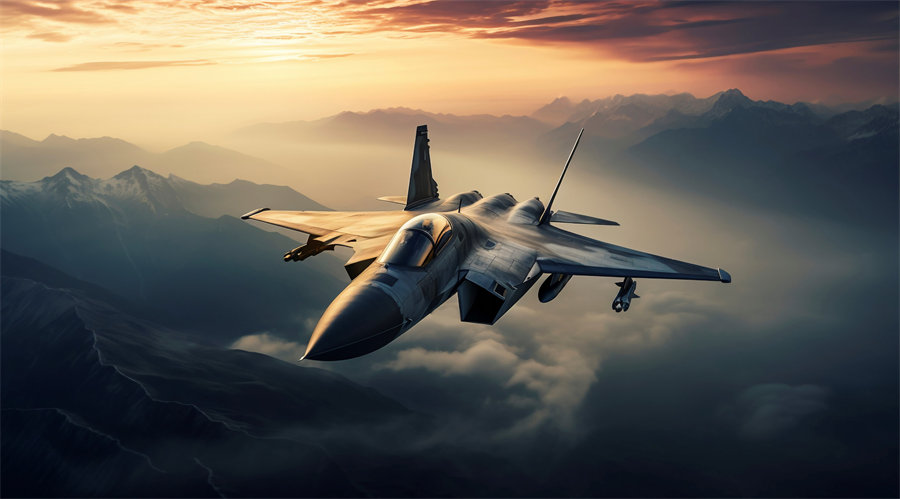
MIL-DTL-38999 connectors are the go-to choice for fighter jets, commercial aircraft, spacecraft, missile systems, ground combat vehicles, naval vessels, high-performance industrial equipment, and critical medical devices where unwavering performance in harsh, demanding conditions is non-negotiable.
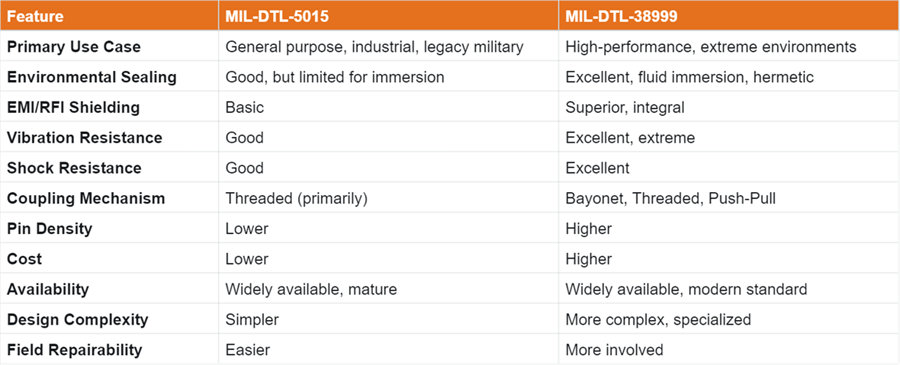
MIL-DTL-5015 vs MIL-DTL-38999: Head-to-Head Comparison Table
To summarize the key differences, here's a direct comparison:
Choosing the Right Connector: Factors to Consider
Deciding between a MIL-DTL-5015 and a MIL-DTL-38999 connector ultimately boils down to a careful assessment of your specific application's requirements. Here are the critical factors to weigh:
- Environmental Conditions: This is paramount. Does your application face constant moisture, extreme temperatures, corrosive chemicals, high vibration, or severe shock? If so, the superior sealing and ruggedness of a MIL-DTL-38999 are likely essential. For less extreme industrial environments, a MS5015 might suffice.
- Performance Requirements: Consider signal integrity and power handling. Are you dealing with sensitive signals that require robust EMI/RFI shielding? Do you need to minimize voltage drop over long distances? MIL-DTL-38999 generally offers superior electrical performance in challenging conditions.
- Space & Weight Constraints: If your design is space-constrained or weight-sensitive (e.g., in aerospace), the higher pin densities and smaller form factors of MIL-DTL-38999 might be a significant advantage.
- Budget: Cost is always a factor. If a MIL-DTL-5015 can meet all your performance and environmental requirements, its lower cost can provide substantial savings, especially for large-scale projects. However, never compromise on safety or reliability to save costs where performance is critical.
- Lifecycle & Longevity: Consider the expected lifespan of your system and its maintenance plan. While 5015s are easier to field repair, the enhanced durability and sealing of 38999s can lead to less frequent repairs in demanding conditions.
- Specific Industry Standards/Certifications: Does your application require adherence to specific industry or military standards that mandate a particular connector series? Always verify compliance.
- Legacy vs. New Design: Are you upgrading an existing system where 5015s are already in place, or are you designing a brand-new system from scratch? Compatibility with existing infrastructure can influence your choice.
Conclusion
Both MIL-DTL-5015 and MIL-DTL-38999 are formidable military-standard circular connectors, each with its unique strengths and optimal use cases. The MIL-DTL-5015 series, with its long history and robust simplicity, remains a cost-effective and reliable choice for general-purpose industrial and less extreme military applications. Conversely, the MIL-DTL-38999 series stands as the modern benchmark for high-performance applications that demand unparalleled environmental sealing, superior EMI/RFI shielding, and extreme resistance to vibration and shock.
Choosing between MIL-DTL-5015 vs MIL-DTL-38999 is not about one being inherently "better" than the other, but rather about selecting the connector that perfectly aligns with your application's unique environmental conditions, performance demands, and budget considerations. By carefully evaluating these factors, you can ensure your critical systems are equipped with connections that are not just reliable, but truly optimized for their mission.
Still unsure which connector is right for your project? Consulting with Metabee’s connector experts can provide invaluable guidance tailored to your specific needs.
