
Automotive engineering is evolving rapidly. Mechanical vehicles are becoming "computers on wheels." This shift completely changes internal vehicle architectures. High-frequency, reliable data transmission is now essential. The FAKRA connector solves this need perfectly. It is a specialized radio frequency (RF) coaxial connector. FAKRA is now the absolute standard for vehicle telematics, infotainment, and Advanced Driver Assistance Systems (ADAS).
What makes a connector a "FAKRA" connector? How does it differ from standard telecom RF interconnects? Why do engineers trust it for next-generation autonomous vehicles?
This comprehensive guide offers a deep technical dive into FAKRA connectors. We will explore their origins, structure, specifications, and the universal color-coding system. We will also compare them with SMB connectors, discuss testing standards, and outline the future of RF connectivity.
Introduction: Demystifying FAKRA Connectors
You must look at the unique vehicle environment to understand FAKRA's dominance. Vehicle electronics face extreme temperatures, constant vibration, and corrosive fluids. Stationary consumer electronics do not face these harsh conditions. Standard RF connectors fail here and lose signal integrity.
The Origins and Definition of FAKRA
The term FAKRA stands for Fachkreis Automobil. This means the Automobile Expert Group. German automotive experts formed this group. They saw the urgent need for a standard, high-performance RF connector. It needed to survive harsh environments and remain cost-effective for mass production.
A FAKRA connector is a subminiature RF coaxial connector inside a rugged plastic shell. It transmits high-frequency signals with minimal loss. It ensures data from antennas, cameras, and sensors reaches the Electronic Control Unit (ECU) instantly. At Metabee, we engineer our FAKRA connectors to exceed these exact automotive demands.
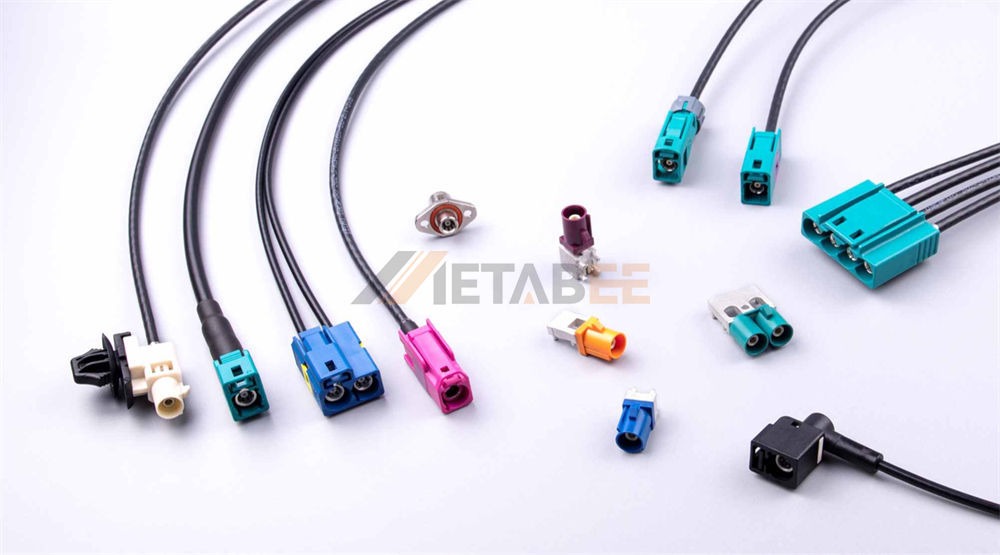
Metabee Fakra Connectors and Cable Assemblies
Core Industry Standards: DIN 72594-1 and USCAR-18
Standard compliance is non-negotiable in B2B components. Two primary international standards govern FAKRA connector design, dimensions, and performance:
DIN 72594-1: This standard originated in Germany. It establishes the basic dimensions and mechanics. It defines the plastic housing geometry, mechanical keying, and color codes. This ensures global interoperability.
USCAR-18: The United States Council for Automotive Research (USCAR) adopted and expanded these rules. USCAR-18 defines performance and validation requirements for North America. It mandates strict testing for mating force, retention force, and vibration resistance.
By following these standards, manufacturers guarantee seamless integration. A FAKRA connector from Supplier A will work perfectly with an ECU from Supplier B.
Anatomy of a FAKRA Connector: Structure and Materials
To understand how FAKRA connectors perform so well, you must look inside. A complete FAKRA connector consists of four primary precision-engineered components.
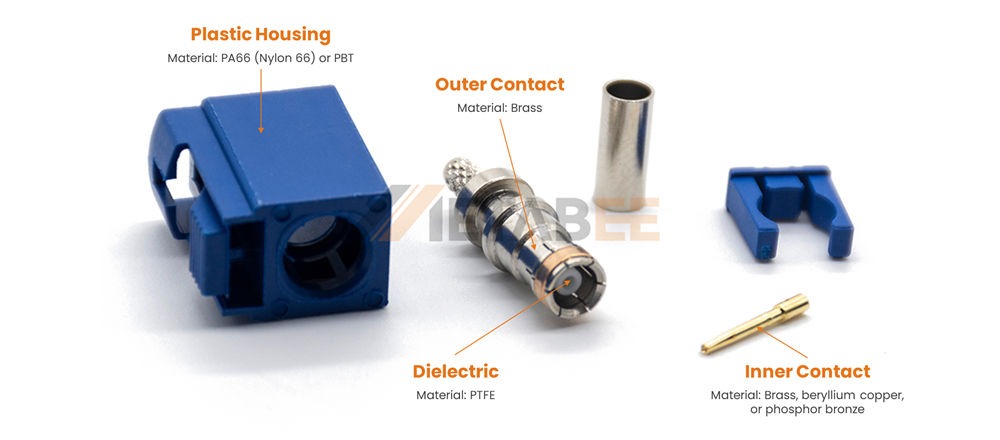
1. The Plastic Housing (Outer Shell)
Manufacturers mold the rugged outer shell from high-performance plastics. Common materials include PA66 (Nylon 66) or PBT. This housing provides the color-coded keying and the mechanical locking latch. It physically protects the delicate internal metals from drops, impacts, and dust on the assembly floor.
2. The Outer Contact (Shielding Body)
This is the main metal body of the internal SMB interface. Manufacturers typically machine it from brass or use zinc die-casting. They then heavily plate it with nickel. This outer body provides structural strength. More importantly, it grounds the coaxial connection and blocks incoming Electromagnetic Interference (EMI).
3. The Inner Contact (Center Pin/Socket)
This vital component carries the actual high-frequency RF signal. Engineers design the male pins using brass and the female sockets using beryllium copper or phosphor bronze. These specific metals offer high conductivity and excellent spring properties. Manufacturers then plate the inner contact with high-quality gold. Gold ensures ultra-low contact resistance and prevents oxidation over the vehicle's lifespan.
4. The Dielectric (Insulator)
A precise plastic cylinder sits tightly between the inner contact and the outer body. Manufacturers almost exclusively use PTFE (Teflon) for this part. PTFE easily handles the high temperatures of the PCB soldering process. Crucially, its exact dimensions maintain the strict 50-ohm electrical impedance required for clean RF transmission.
Core Technical Specifications and RF Performance
A connector is only as good as its specifications. FAKRA connectors balance high-frequency electrical performance with extreme mechanical durability.
Electrical Characteristics
A FAKRA connector moves RF signals with maximum efficiency. The standard electrical specifications include:
Impedance: 50 Ohms (nominal). This balances power handling and signal loss.
Frequency Range: They operate from DC up to 6 GHz. This handles everything from AM/FM radio to high-speed 5G and camera feeds.
VSWR (Voltage Standing Wave Ratio): This measures signal reflection. FAKRA connectors boast an excellent VSWR (typically < 1.30). This ensures very low Return Loss.
Mechanical Robustness and Environmental Resilience
The mechanical housing must protect the sensitive electrical core.
Temperature Range: Automotive environments are brutal. FAKRA connectors typically operate from -40°C to +105°C. High-temp PA-66 plastic versions can withstand even higher temperatures.
Locking Mechanisms: The plastic housing features a robust primary locking latch. It produces a loud "click" upon full mating. Many designs also use a CPA (Connector Position Assurance) clip. This secondary lock prevents disengagement under heavy vibration.
Summary of Key FAKRA Specifications
|
Parameter |
Standard Specification |
Note |
|
Impedance |
50 Ω |
Standard RF impedance |
|
Frequency Range |
DC to 6.0 GHz |
Supports 5G and ADAS sensors |
|
VSWR |
≤ 1.30 (Typical) |
Ensures low signal reflection |
|
Operating Temp. |
-40°C to +105°C |
High-temp plastics available |
|
Mating Cycles |
≥ 25 Cycles |
Optimized for factory assembly |
|
Retention Force |
> 110 N |
Prevents accidental pull-outs |
Looking for detailed spec sheets? Contact Metabee today to get full product datasheets.
The FAKRA Color Coding System and Application Mapping
The standardized color-coding and mechanical keying system is a brilliant feature. It engineers human error out of the assembly process.
Preventing Mis-Mating with Mechanical Keying (Poka-Yoke)
Automotive wire harnesses are highly complex. They often group many similar-looking RF connections. An assembly worker might accidentally plug a GPS cable into a cellular port. This mistake breaks the navigation system.
DIN 72594-1 uses a Poka-Yoke (error-proofing) design to stop this. The plastic housing features specific internal ribs and external slots. "Keying A" only fits into a "Keying A" receptacle. The mechanical ribs block incorrect connections entirely.
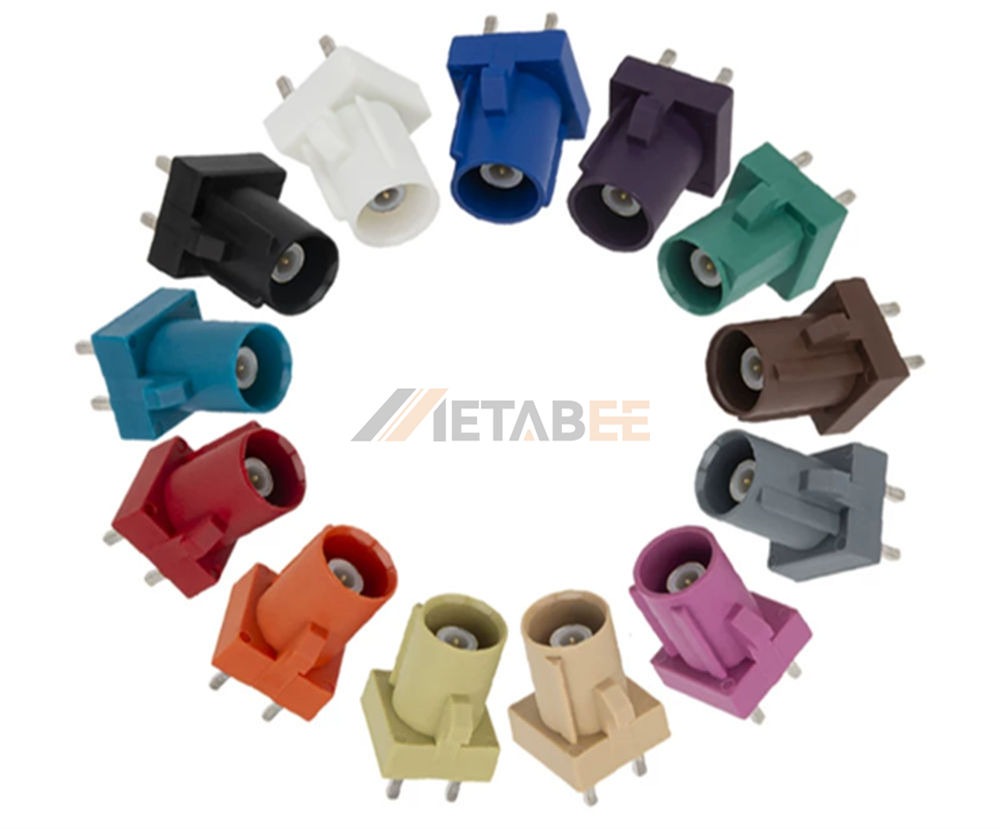
Color Coding of Fakra Connectors
Comprehensive FAKRA/USCAR Coding Chart
Every unique mechanical keyway has a specific, standardized color. Manufacturers use the RAL color standard to ensure exact color matching across global factories.
Here is the complete reference table for FAKRA codes, their precise RAL numbers, and applications:
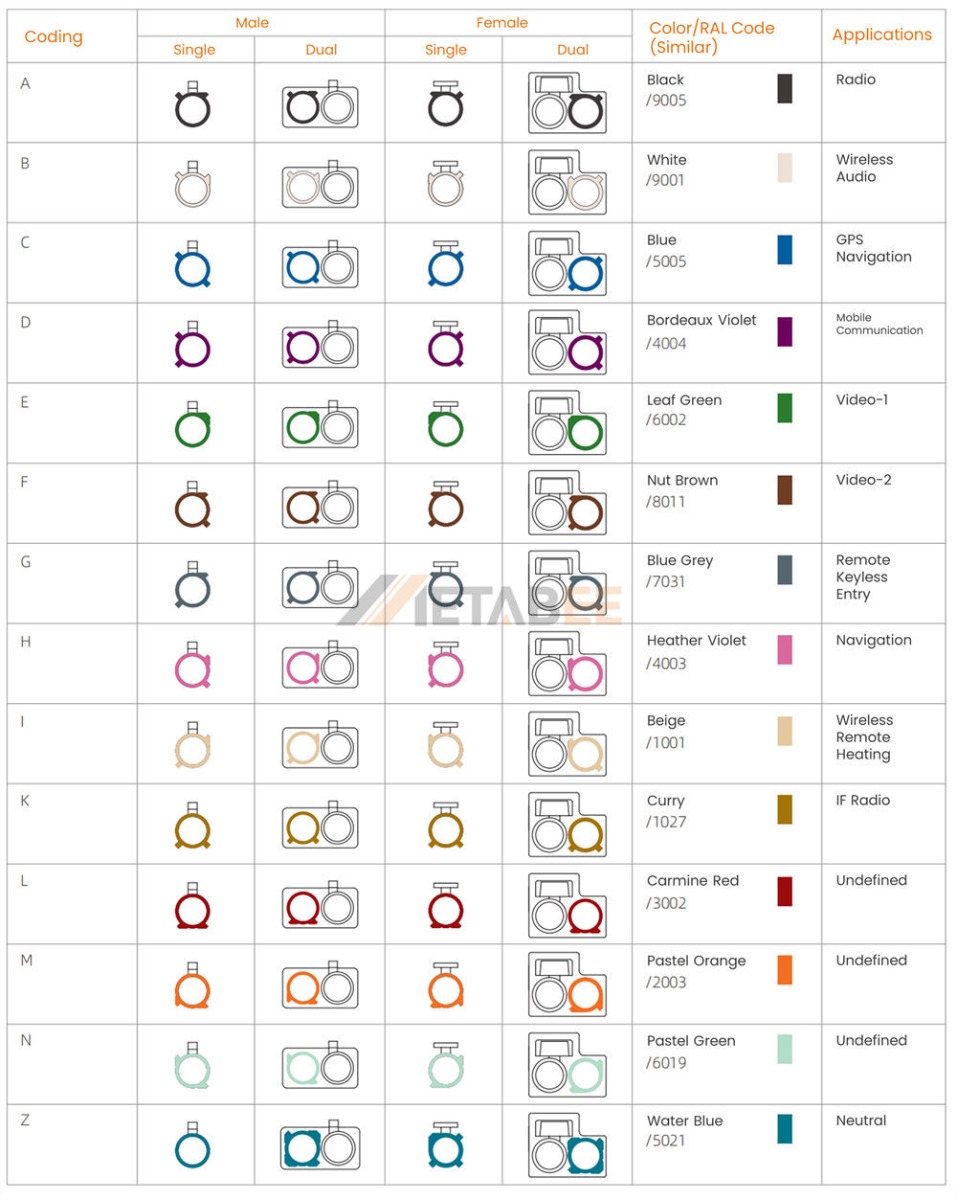
OEM designers dramatically speed up assembly times and reduce costly rework by strictly following this table.
FAKRA vs. SMB Connectors: Understanding the Relationship
Engineers often ask a common question: Is the inside metal part just an SMB connector? Yes, but it has critical automotive upgrades.
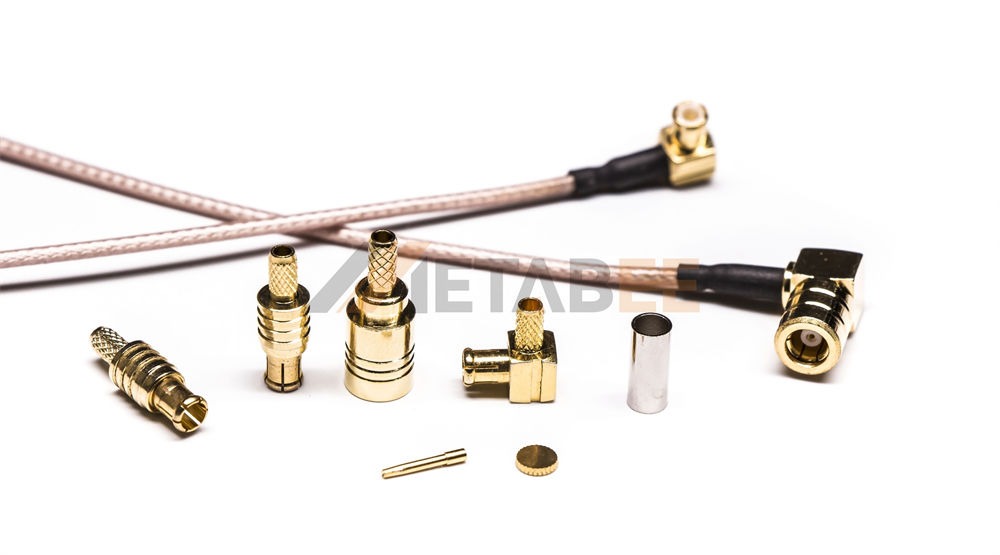
The SMB Core Interface
The SMB (Subminiature version B) is a legacy RF connector from the 1960s. It uses a snap-on coupling mechanism. It provides excellent performance up to 4 GHz. Every standard FAKRA connector holds this exact SMB metal core inside. Metabee precision-manufactures this internal SMB interface to guarantee ultra-low insertion loss before sealing it.
The FAKRA Automotive Upgrade
Why not just use bare SMB connectors in cars? The problem is the snap-on design. A friction fit works fine in a telecom rack. But cars drive over potholes. High-frequency vibration causes bare SMB connectors to suffer "fretting." This wears down the plating. The connectors eventually back out and cause signal loss.
FAKRA fixes this entirely. It wraps the SMB core in rugged plastic.
Mechanical Locking: FAKRA uses a strong plastic latch. Vibration cannot pull it apart.
Keying: FAKRA adds 14 keyways to stop cross-wiring.
Protection: The housing shields the delicate metal core from physical impacts on the factory floor.
In short: FAKRA is an SMB connector wearing heavy-duty, automotive-grade armor.
The Next Generation: FAKRA vs. Mini-FAKRA (HFM)
As vehicle architectures shift toward centralized computing and Level 4 autonomous driving, the demand for data bandwidth has skyrocketed. While standard FAKRA connectors are excellent for traditional RF signals, the industry required an even smaller, faster solution for 4K uncompressed cameras and high-resolution LiDAR arrays.
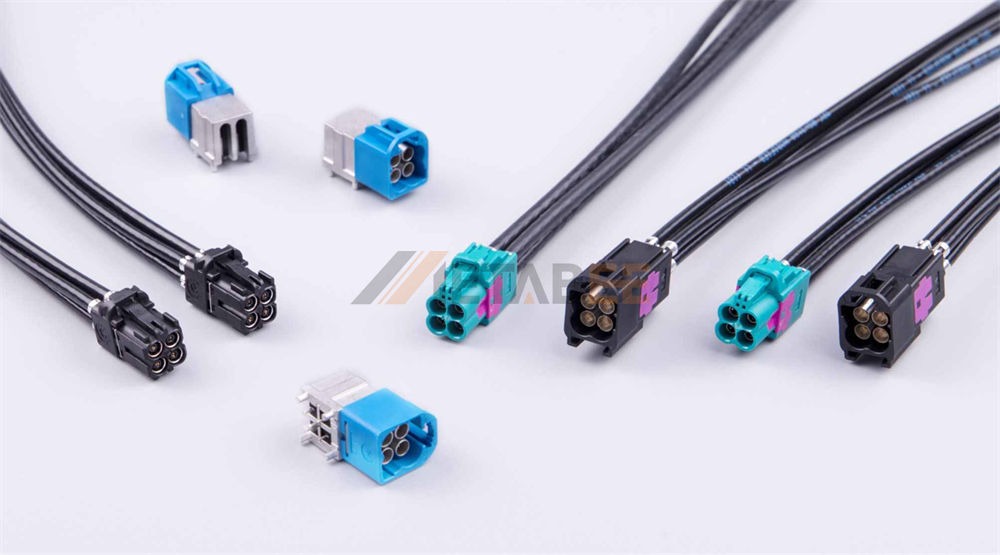
This requirement led to the development of the Mini-FAKRA, commonly known as HFM (High-Speed FAKRA Mini).
Size and Space Efficiency
The most obvious difference is the physical footprint. Dashboard and ECU panel space is highly limited. Mini-FAKRA connectors are specifically designed for high-density applications. By utilizing quad-port configurations, Mini-FAKRA connectors can save up to 80% of PCB space compared to using four individual standard FAKRA connectors.
Frequency and Data Rate Limits
While standard FAKRA is rated up to 6 GHz, Mini-FAKRA shatters this limit. It operates reliably at frequencies up to 20 GHz. This massive leap in frequency allows Mini-FAKRA to support ultra-fast data transmission rates of up to 28 Gbps, making it the superior choice for modern PCIe automotive networks.
Quick Comparison: Standard FAKRA vs. Mini-FAKRA
|
Feature |
Standard FAKRA |
Mini-FAKRA (HFM) |
|
Max Frequency |
Up to 6.0 GHz |
Up to 20.0 GHz |
|
Max Data Rate |
~8 Gbps |
Up to 28 Gbps |
|
Space Efficiency |
Baseline standard |
Up to 80% space reduction |
|
Primary Use Cases |
GPS, AM/FM, Basic Telematics |
4K Cameras, LiDAR, Autonomous ECUs |
Considerations for Wire Harness Assembly
Procuring the right components is only the first step. You determine the true reliability during the wire harness assembly process.
Coaxial Cable Compatibility
You terminate FAKRA connectors onto flexible coaxial cables. You must choose the right cable to balance flexibility, signal loss, and cost.
RG-174: A flexible, low-cost cable. Great for short runs.
RG-316: Handles higher temperatures better than RG-174.
RG-58 / RTK-031: Thicker cables with lower insertion loss. Ideal for longer runs through the vehicle chassis.
The Crimping Process: Precision is Paramount
Terminating RF cables requires intense precision. You must strip the jacket, shield, and dielectric to exact millimeter tolerances. You crimp the center pin onto the inner conductor. Then, you crimp a metal ferrule over the shield. This secures the ground and provides mechanical strain relief.
Automated coaxial stripping and crimping machines are mandatory for high-volume production. They maintain the strict VSWR limits required by IPC standards.
Validation and Testing Standards
Automotive components cannot just work; they must survive. FAKRA connectors undergo rigorous testing to meet OEM approvals.
Thermal Shock: Connectors cycle rapidly between -40°C and +105°C to ensure the plastic housing does not crack and the metal pins maintain contact.
Vibration Testing: Assemblies shake on multi-axis tables for hours to simulate years of driving. The CPA (Connector Position Assurance) lock must remain engaged.
Salt Spray Test: This tests corrosion resistance, ensuring the metal plating survives exposure to road salt and humidity.
Related Products
Conclusion: Let's Build Your Next RF Solution
The automotive industry is moving fast toward fully autonomous driving. Vehicles now process staggering volumes of data. Cameras, LiDAR, radar, and 5G communications need perfect signal integrity.
The FAKRA connector remains the strong backbone of this data revolution. Automotive engineers can guarantee absolute reliability by understanding its specs, materials, RAL coding rules, and mating standards.
Are you developing the next generation of vehicle connectivity? Partner with Metabee. We provide high-performance FAKRA and Mini-FAKRA connectors, alongside custom wire harness solutions that meet strict USCAR standards.
Contact us today to request free product samples, or consult with our RF engineering team for a quick quote!
Frequently Asked Questions (FAQ)
Q: Can FAKRA connectors be waterproof?
A: Standard FAKRA connectors are not waterproof. However, manufacturers offer sealed FAKRA connectors. These utilize internal O-rings and silicone seals to achieve IP67 or IP69K ratings, making them suitable for exterior cameras and sensors.
Q: What is the difference between FAKRA and HSD connectors?
A: FAKRA is a single-pin coaxial connector used for RF signals. HSD (High-Speed Data) is a four-pin shielded connector designed for high-speed digital data protocols like LVDS, USB, and Ethernet.
Q: What does "Phantom Power" mean in FAKRA applications?
A: Phantom power means the FAKRA cable carries both the high-frequency RF signal and a low DC voltage (usually to power an active antenna) over the same center wire simultaneously. Code B FAKRA connectors often indicate this application.
Q: What is the maximum cable length for a FAKRA connector?
A: The maximum length depends heavily on the cable type and the signal frequency. For high-frequency signals (like 5G) using thin RG-174 cable, signal attenuation becomes severe after 2 to 3 meters. For longer runs through a vehicle chassis, engineers must specify lower-loss cables like RTK-031 or integrate inline signal amplifiers.
Q: Can I use FAKRA connectors in non-automotive applications?
A: Absolutely. While designed for the automotive industry, their ruggedness makes them increasingly popular in other fields. Engineers frequently use them in industrial automation, ruggedized outdoor telecom equipment, and marine electronics because of their secure locking and reliable 50-ohm RF performance.
Q: How do you properly unmate a FAKRA connector?
A: To unmate a FAKRA connector, you must first slide back the secondary locking clip (CPA) if one is present. Next, press down firmly on the primary plastic release latch located on the housing to clear the catch. Finally, gently pull the connectors apart. Never pull directly on the coaxial cable, as this destroys the internal crimp.
