
Introduction to D38999 Connectors
D38999 connectors, also known as MIL-DTL-38999 connectors, are a series of high-density, miniature circular connectors designed to meet the rigorous demands of military and aerospace applications. They are manufactured in compliance with the MIL-DTL-38999 standard. Previously, this standard was designated as MIL-C-38999, which is why many people still refer to them as MIL-C-38999 connectors. These connectors are durable and can resist environmental factors like vibration, shock, moisture, and EMI/RFI. So, they can provide reliable performance in critical systems.
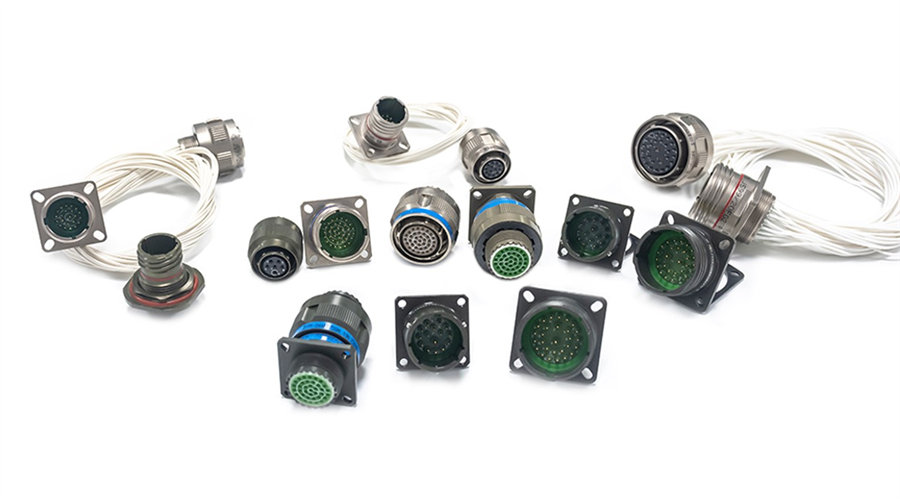
The D38999 family is broadly categorized into four distinct series, each offering unique features and advantages:
D38999 Series I Connectors: Bayonet Coupling, Rear-Removable Crimp Contacts
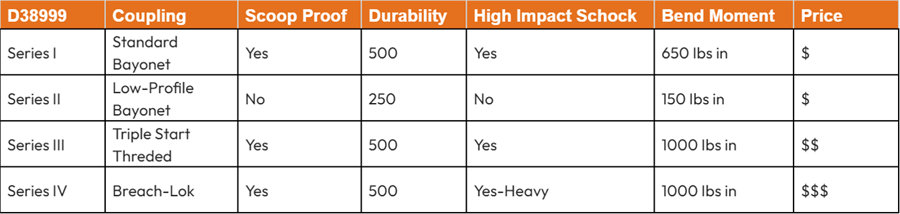
These connectors are often referred to by their designations, including MS27467, MS27466, MS27656, MS27496, MS27505, MS27468, and MS27901. D38999 series I connectors feature a bayonet coupling mechanism for quick and secure mating. They are highly resistant to vibration and are widely used in applications where space is less of a constraint. The contacts are rear-removable, simplifying maintenance and repair.
D38999 Series II Connectors: Miniature, Bayonet Coupling, Rear-Removable Crimp Contacts
These connectors are known by their designations, including MS27484, MS27473, MS27472, MS27513, MS27497, MS27508, and MS27474. D38999 series II connectors are a miniaturized version of Series I. They offer a compact, lightweight design with the same reliable bayonet coupling and rear-removable crimp contacts, making them ideal for applications where size and weight are critical factors.
D38999 Series III Connectors: Triple-Start Threaded Coupling, Rear-Removable Crimp Contacts
This is arguably the most prevalent series, identified by 3 designations, including D38999/20, D38999/24, and D38999/26. Series III connectors boast a triple-start threaded coupling that allows for rapid mating and unmating in just 1.5 turns. Their superior vibration resistance and "scoop-proof" design make them highly reliable in the harshest environments.
D38999 Series IV Connectors: Breech-Lock Coupling, Rear-Removable Crimp Contacts
While less common than Series III, Series IV is characterized by its breech-lock coupling mechanism. This unique design provides extremely quick mating and unmating while maintaining high vibration resistance and excellent EMI shielding. It's often chosen for applications requiring rapid connect/disconnect cycles.
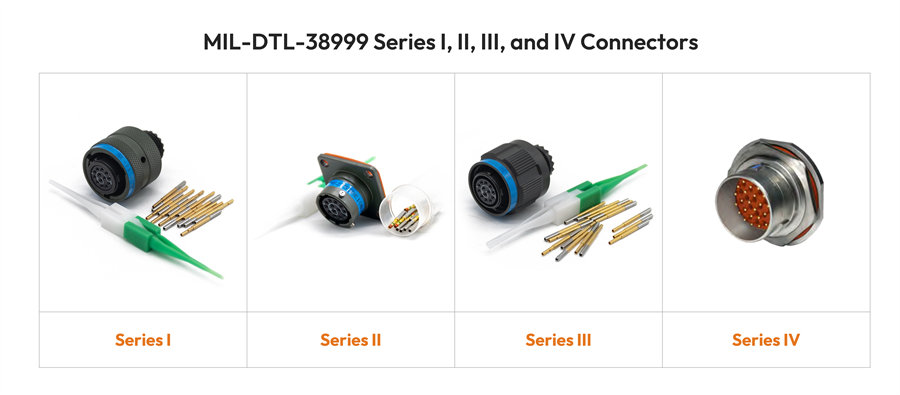
The main comparison of the four D38999 connector series is shown in the table below:
Why D38999 Part Number Breakdown is Crucial?
Understanding the D38999 part number breakdown is far more than just an academic exercise; it’s a critical skill that impacts every stage of a product's lifecycle. Here’s why mastering this alphanumeric language is so important:
- Precision in Specification: Imagine designing a complex system. Specifying the exact connector needed, down to the shell size, contact type, plating, and keying, is paramount. A precise understanding of the part number ensures that the correct component, with all its specific features, is chosen. It’s the best way to prevent costly design errors, performance issues, and even safety hazards.
- Interchangeability and Compatibility: The MIL-DTL-38999 standard was established to ensure that connectors from different qualified manufacturers are interchangeable and compatible when their part numbers align. Knowing the breakdown allows you to confidently source equivalent connectors from various suppliers.
- Streamlined Procurement and Inventory: For purchasing agents and inventory managers, the part number is the "DNA" of the connector. Understanding its segments allows for quick and accurate ordering, reduced lead times, and efficient inventory management. It minimizes the risk of ordering incorrect parts, which can lead to production delays and increased costs.
- Troubleshooting and Maintenance: When a system needs repair or an upgrade, rapidly identifying the exact connector is vital. The part number acts as a complete specification guide, enabling maintenance technicians to quickly determine the connector's characteristics, identify replacement parts, and ensure proper reassembly, minimizing downtime.
D38999 Part Number Breakdown by Series
While each series has its unique designators, there's a common logic to how D38999 part numbers are structured. Each segment of the part number typically represents a specific characteristic of the connector. Let's break down the typical structure for each series.
Series I (MIL-DTL-38999 Series I) Part Number Breakdown
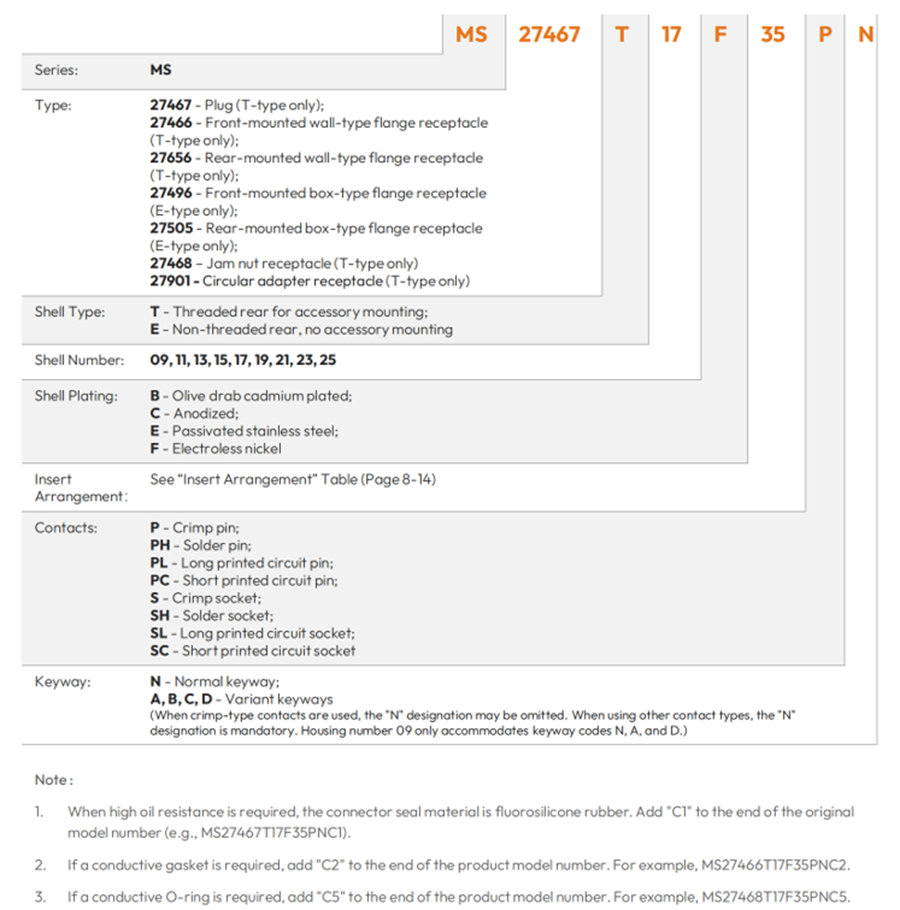
Example Part Number: MS27467T17F35PN
1. Connector Type: MS27467
27467 - Plug (T-type only)
27466 - Front-mounted wall-type flange receptacle (T-type only)
27656 - Rear-mounted wall-type flange receptacle (T-type only)
27496 - Front-mounted box-type flange receptacle (E-type only)
27505 - Rear-mounted box-type flange receptacle (E-type only)
27468 – Jam nut receptacle (T-type only)
27901 - Circular adapter receptacle (T-type only)
2. Shell Type: T
T - Threaded rear for accessory mounting
E - Non-threaded rear, no accessory mounting
3. Shell Size: 17
This number directly corresponds to the diameter of the connector's mating face, influencing the number and size of contacts it can accommodate. These shell sizes include 09, 11, 13, 15, 17, 19, 21, 23, and 25.
4. Shell plating: F
B - Olive drab cadmium plated
C - Anodized
E - Passivated stainless steel
F - Electroless nickel
5. Insert arrangement: 35
This code defines the specific layout and number of contacts within the connector insert. Each arrangement is standardized to ensure Interchangeability. You can check this number in Metabee’s D38999 catalog.
6. Contact Type: S
P - Crimp pin
PH - Solder pin
PL - Long printed circuit pin
PC - Short printed circuit pin
S - Crimp socket
SH - Solder socket
SL - Long printed circuit socket
SC - Short printed circuit socket
7. Keyway: N
N - Normal keyway;
A, B, C, D - Variant keyways
Download Metabee’s D38999 catalog to learn more about these keyways.
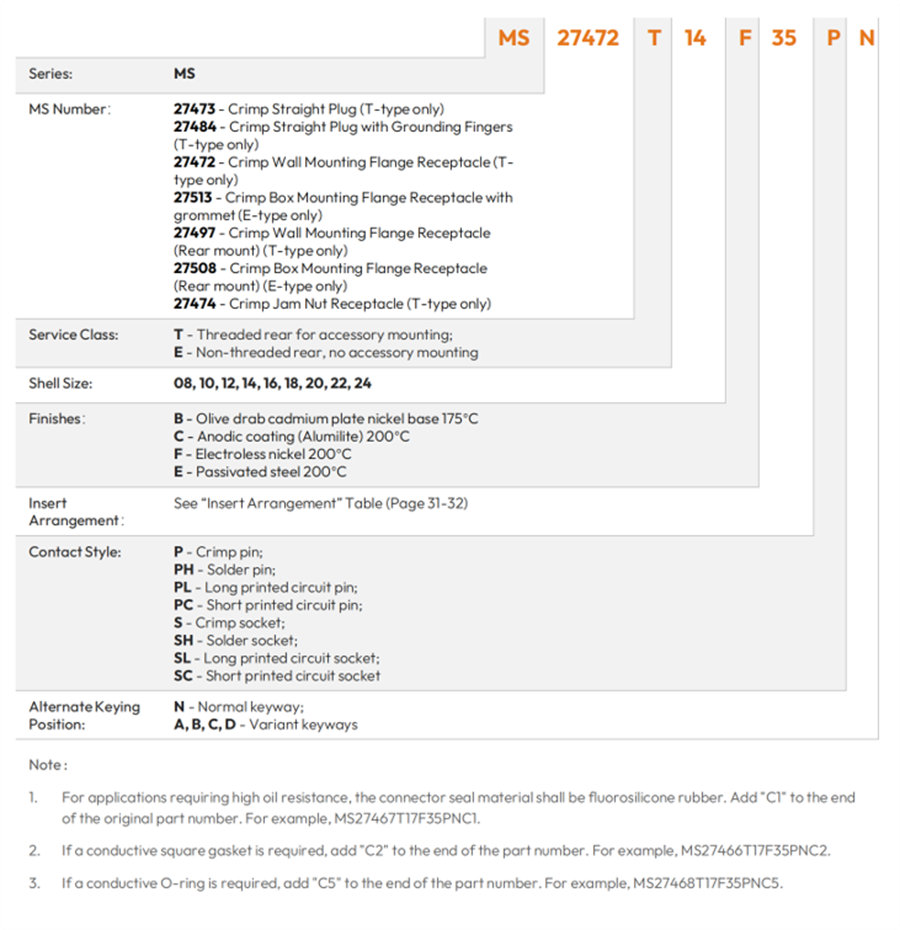
Series II (MIL-DTL-38999 Series II) Part Number Breakdown
Example Part Number: MS27472T14F35PN
1. Connector Type: MS27472
27473 - Crimp Straight Plug (T-type only)
27484 - Crimp Straight Plug with Grounding Fingers (T-type only)
27472 - Crimp Wall Mounting Flange Receptacle (T-type only)
27513 - Crimp Box Mounting Flange Receptacle with grommet (E-type only)
27497 - Crimp Wall Mounting Flange Receptacle (Rear mount) (T-type only)
27508 - Crimp Box Mounting Flange Receptacle (Rear mount) (E-type only)
27474 - Crimp Jam Nut Receptacle (T-type only)
2. Shell Type: T
T - Threaded rear for accessory mounting
E - Non-threaded rear, no accessory mounting
3. Shell Size: 14
This number directly corresponds to the diameter of the connector's mating face, influencing the number and size of contacts it can accommodate. These shell sizes include 08,10,12,14,16, 18, 20, 22, and 24.
4. Shell plating: F
B - Olive drab cadmium plated
C - Anodized
E - Passivated stainless steel
F - Electroless nickel
5. Insert arrangement: 35
This code defines the specific layout and number of contacts within the connector insert. Each arrangement is standardized to ensure Interchangeability. You can check this number in Metabee’s D38999 catalog.
6. Contact Type: S
P - Crimp pin
PH - Solder pin
PL - Long printed circuit pin
PC - Short printed circuit pin
S - Crimp socket
SH - Solder socket
SL - Long printed circuit socket
SC - Short printed circuit socket
7. Keyway: N
N - Normal keyway;
A, B, C, D - Variant keyways
Download Metabee’s D38999 catalog to learn more about these keyways.
Series III (MIL-DTL-38999 Series III) Part Number Breakdown
Series III is the most widely adopted and typically starts with "D38999/" followed by a series-specific dash number.
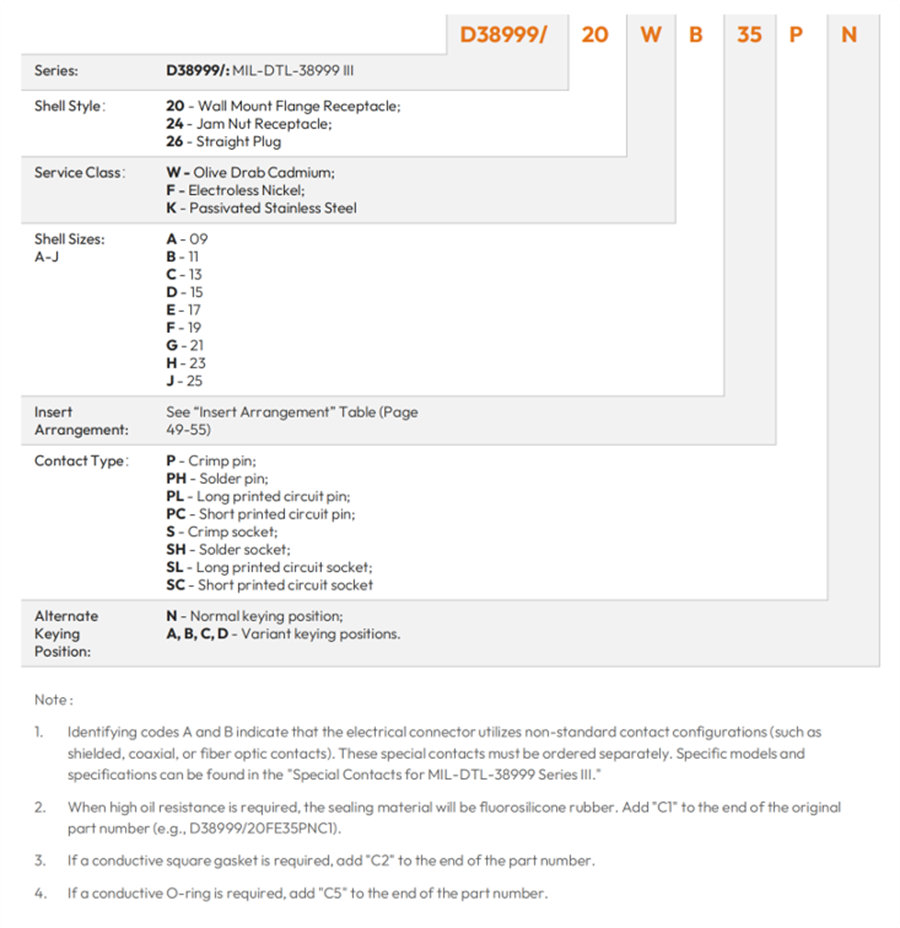
Example Part Number: D38999/20WB35PN
1. Series: D38999/
D38999 represents MIL-DTL-38999.
2. Shell Style: 20
20 - Wall Mount Flange Receptacle
24 - Jam Nut Receptacle
26 - Straight Plug
3. Service Class: W
W - Olive Drab Cadmium
F - Electroless Nickel
K - Passivated Stainless Steel
4. Shell Size: B
A - 09
B - 11
C - 13
D - 15
E - 17
F - 19
G - 21
H - 23
J - 25
5. Insert Arrangement: 35
This code defines the specific layout and number of contacts within the connector insert. Each arrangement is standardized to ensure Interchangeability. You can check this number in Metabee’s D38999 catalog.
6. Contact Type: P
P - Crimp pin;
PH - Solder pin;
PL - Long printed circuit pin;
PC - Short printed circuit pin;
S - Crimp socket;
SH - Solder socket;
SL - Long printed circuit socket;
SC - Short printed circuit socket
7. Keyway: N
N - Normal keyway;
A, B, C, D - Variant keyways
Download Metabee’s D38999 catalog to learn more about these keyways.
Series IV (MIL-DTL-38999 Series IV) Part Number Breakdown
Series IV connectors, with their unique breech-lock mechanism, follow a similar but distinct numbering scheme.
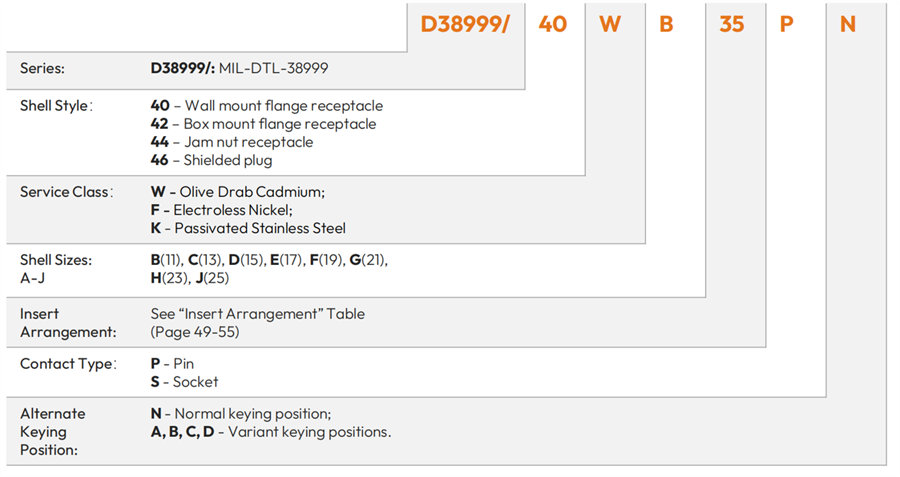
Example Part Number: D38999/40WB35PN
1. Series: D38999/
D38999 represents MIL-DTL-38999
2. Shell Style: 40
40 – Wall mountflange receptacle
42 – Box mount flange receptacle
44 – Jam nut receptacle
46 – Shielded plug
3. Service Class: W
W - Olive Drab Cadmium
F - Electroless Nickel
K - Passivated Stainless Steel
4. Shell Size: B
B - 11
C - 13
D - 15
E - 17
F - 19
G - 21
H - 23
J - 25
5. Insert Arrangement: 35
This code defines the specific layout and number of contacts within the connector insert. Each arrangement is standardized to ensure Interchangeability. You can check this number in Metabee’s D38999 catalog.
6. Contact Type: P
P - Pin
S – Socket
7. Keyway: N
N - Normal keyway;
A, B, C, D - Variant keyways
Download Metabee’s D38999 catalog to learn more about these keyways.
Important Note: All Metabee's D38999 connectors follow the part numbering rules mentioned above. Our part numbers comply with the MIL-DTL-38999 standard. However, many manufacturers have their own part numbering systems, so when selecting products, please refer to the manufacturer's datasheets or contact them directly.
Additionally, due to the vast number of D38999 connector variants, we have only listed a selection of models on our website. If you cannot find the specific model you need, please feel free to contact us.
Why Choose Metabee for D38999 Connectors?
When your application demands the absolute best in rugged, reliable connectivity, the choice of supplier is just as critical as understanding the connector itself. Metabee stands out as a premier provider of D38999 connectors, offering a combination of quality, breadth of product, and customer focus that makes them an ideal partner.
- Uncompromising Quality and Reliability: Metabee is committed to manufacturing D38999 connectors that meet or exceed the stringent requirements of MIL-DTL-38999. Their rigorous quality control processes and use of high-grade materials ensure that every connector performs flawlessly, even in the most extreme conditions. When you choose Metabee, you're choosing reliability you can count on.
- Extensive Product Range: Whether you need a Series I bayonet-style connector, a compact Series II, the ubiquitous Series III threaded connector, or a rapid-mating Series IV, Metabee offers an incredibly comprehensive range. Their catalog includes a vast selection of shell styles (plugs, receptacles, wall mount, jam nut), finishes (cadmium, electroless nickel, black anodized, stainless steel), and an exhaustive list of contact insert arrangements to fit virtually any design requirement.
- Customization Options: Not every application fits a standard mold. Metabee understands this and provides robust customization options for D38999 connectors. Whether you need specialized materials, unique plating, custom insert arrangements, or integrated cable assemblies, their engineering team can work with you to develop a tailored solution that meets your precise specifications.
- Competitive Pricing: Delivering superior quality doesn't have to break the bank. Metabee strives to offer highly competitive pricing for their D38999 connector range. They optimize their manufacturing processes and supply chain to provide cost-effective solutions without ever compromising on the integrity or performance of their products.
- Expert Support and Service: Navigating the complexities of mil-spec connectors can be challenging. Metabee boasts a team of knowledgeable technical support specialists who are well-versed in D38999 specifications and applications. They provide exceptional pre-sales consultation and post-sales support, ensuring you have the information and assistance you need at every step.
Conclusion
Mastering the D38999 part number breakdown is an essential skill for anyone working with these critical military-spec connectors. We've explored how each segment of the part number, from series designation and shell type to finish and contact arrangement, precisely defines a connector's characteristics and capabilities. This understanding isn't just about technical knowledge; it's vital for accurate specification, ensuring compatibility, streamlining procurement, and simplifying maintenance across countless high-stakes applications.
By decoding these alphanumeric sequences, you gain the power to select the perfect interconnect solution for even the most demanding environments. When choosing a supplier, prioritizing those like Metabee who offer a vast selection, unwavering quality, and expert support ensures you're equipped with reliable connectors built to perform. With this comprehensive knowledge, you're now better prepared to navigate the intricate world of D38999, ensuring precision and reliability in your designs and operations.
FAQs
1. What is the main difference between D38999 Series I, II, III, and IV?
The primary differences lie in their coupling mechanisms (bayonet, threaded, breech-lock) and physical size (Series II is miniature). Each series also has specific design features suited for different environmental challenges and mating speed requirements.
2. How do I determine the correct shell size for my application?
Shell size is determined by the number and gauge of contacts required, as well as any physical space constraints. Larger shell sizes accommodate more contacts or larger gauge wires. Refer to the insert arrangement tables in Metabee’s MIL-DTL-38999 catalog for specific shell size requirements based on contact count.
3. What do the different finishes (e.g., olive drab cadmium, electroless nickel) signify?
Finishes primarily provide corrosion resistance, EMI shielding, and conductivity. Olive drab cadmium is a traditional military finish offering excellent corrosion protection. Electroless nickel provides good corrosion resistance, conductivity, and is a popular cadmium alternative. Other finishes like black anodize or stainless steel offer varying properties for specific environments (e.g., non-reflective, chemical resistance).
4. Can D38999 connectors from different series be cross-mated?
No, they cannot. The coupling mechanisms and keying designs are fundamentally different between series, preventing cross-mating to ensure proper electrical and mechanical integrity.
5. What are the common applications for D38999 connectors?
D38999 connectors are ubiquitous in aerospace (aircraft avionics, missiles), defense (military vehicles, ground support equipment, naval systems), and harsh industrial environments (heavy machinery, oil and gas, railway, renewable energy) where robust, reliable connectivity is essential.
6. How do I ensure proper crimping and installation of D38999 contacts?
Proper installation requires specific crimping tools (indent or four-indent crimpers) and insertion/removal tools matched to the contact size. Adhering strictly to the MIL-STD-22520 (for crimp tools) and the connector manufacturer's instructions is crucial to ensure reliable electrical connections and prevent damage.
7. Are D38999 connectors waterproof or hermetically sealed?
Most standard D38999 connectors offer environmental sealing against moisture, dust, and other contaminants when properly mated. Hermetic versions (typically with glass-to-metal sealed contacts) are available for applications requiring an absolute gas-tight seal, often found in vacuum or pressure-sensitive environments.
If you need Hermetic D38999 connectors, please contact our technical team.
8. What is the typical lifespan of a D38999 connector?
The lifespan depends heavily on the application, mating cycles, and environmental exposure. However, Metabee D38999 connectors are designed for more than 500 mating cycles and decades of reliable service under specified conditions. They are built for extreme longevity.
9. Where can I find detailed specifications and datasheets for D38999 connectors?
The most authoritative source is the official MIL-DTL-38999 military specification documents, available through defense standards organizations. Reputable manufacturers like Metabee also provide detailed product datasheets and catalogs on their websites.
