
In the demanding world of aerospace, defense, and industrial automation, the failure of a single component can lead to catastrophic results. Among the most critical yet often overlooked components are the electrical connectors that ensure the seamless flow of power and signals. One specific standard has stood the test of time, becoming a cornerstone of high-reliability connectivity: the MIL-DTL-26482 connectors.
In this comprehensive guide, we will explore everything you need to know about these miniature circular connectors—from their historical evolution to technical specifications, and how to choose the right series and manufacturer for your project.
What are MIL-DTL-26482 Connectors?
Definition
MIL-DTL-26482 connectors are a family of high-performance, miniature circular connectors characterized by their 3-point bayonet coupling mechanism. This design allows for rapid mating and unmating, providing a secure lock that is far superior to traditional threaded connectors in environments prone to high vibration and mechanical shock.
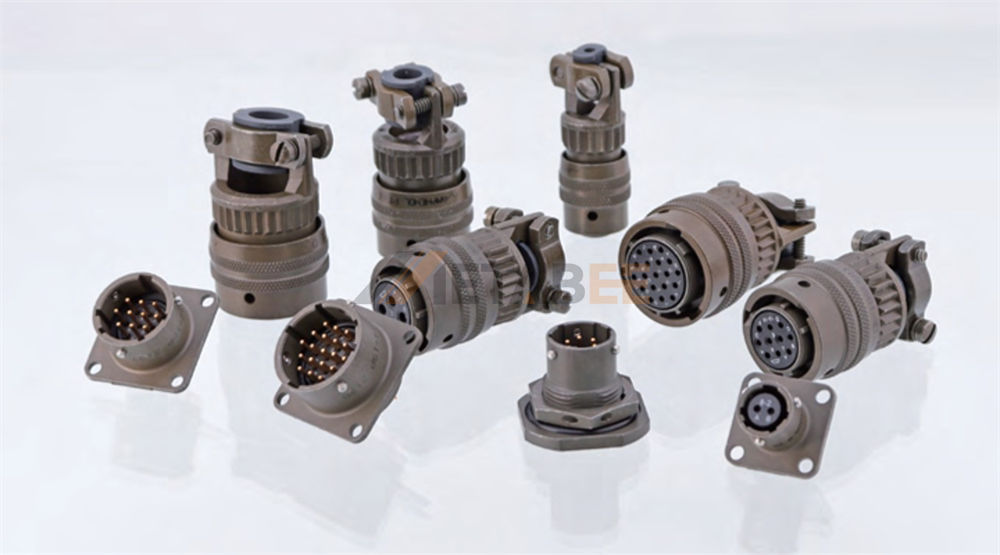
Metabee MIL-DTL-26482 Connectors
Brief History & Standard Evolution
The development of the 26482 standard traces back to the late 1950s, as the U.S. military transitioned into the Cold War era. With the rapid advancement of jet propulsion and missile technology, there was an urgent demand for "miniature" circular connectors that could offer higher contact density than the bulky AN/MS standards of WWII.
By the early 1960s, the MIL-C-26482 specification was officially established, quickly becoming the industry benchmark for tactical communication and avionics. In the late 1990s, as part of a Department of Defense performance-based specification initiative, the standard was redesignated as MIL-DTL-26482. This transition shifted the focus from "MIL-C" (Connector) to "MIL-DTL" (Detail Specification), reflecting a modern approach to procurement while maintaining the rigorous quality levels that engineers have trusted for over six decades.
MIL-DTL-26482 vs. MIL-C-26482
If you have been in the industry for a while, you may still see references to MIL-C-26482. It is important to understand the relationship between these two:
- MIL-C-26482: This was the original designation, where the "C" stood for "Connector."
- MIL-DTL-26482: The current active terminology. The transition was purely administrative to align with modern defense standards.
Key Takeaway for Buyers: Mechanically and electrically, MIL-C-26482 and MIL-DTL-26482 are functionally identical. They are intermateable and interchangeable. However, in modern technical drawings and procurement contracts, "MIL-DTL-26482" is the preferred terminology.
Why MIL-DTL-26482 is the "Gold Standard"
The enduring popularity of these connectors stems from their balance of density and durability. They offer a compact footprint while maintaining an IP67 or IP68 environmental seal when paired with the correct backshells. This makes them indispensable for everything from cockpit avionics to industrial robotic arms.
Key Applications
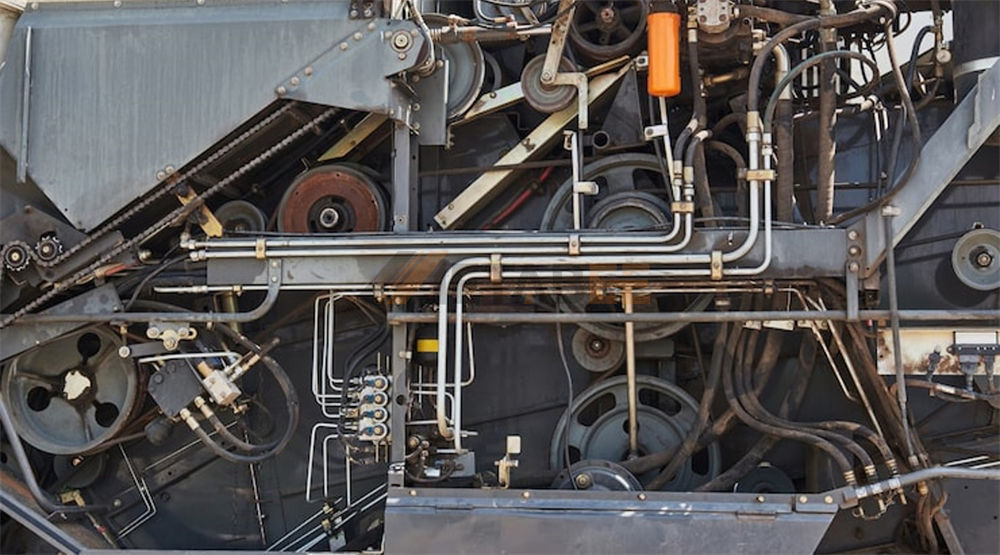
Given their rugged construction and compact size, MIL-DTL-26482 connectors are utilized in a vast array of high-stakes environments:
- Military & Aerospace: Flight control systems, tactical communication units, and engine monitoring sensors.
- Industrial Automation: High-precision CNC machinery, robotic sensors, and heavy-duty factory equipment.
- Energy & Marine: Offshore oil and gas sensors, seismic exploration gear, and marine navigation systems.
- Telecommunications: Ruggedized base stations and field-deployed networking hardware.
Technical Specifications: The Engineering Foundation
To understand why these connectors are so reliable, we must look at the hard data. While specific performance can vary by manufacturer, the MIL-DTL-26482 standard mandates strict minimums.
Electrical Performance
- Contact Current Rating: These connectors are designed to handle a range of power requirements. A standard #20 contact typically handles 7.5A, while larger #16 contacts can handle up to 23A. For #12 contacts, the current rating is 33A.
- Operating Voltage: They are rated for various service classes. Service Class I is rated for 600V AC (RMS) at sea level, while Service Class II is rated for 1,000V AC (RMS).
- Insulation Resistance: Usually a minimum of 5,000M Ohms at 500V DC.
Mechanical Characteristics
- Durability: The bayonet coupling is designed for longevity, rated for a minimum of 500 mating/unmating cycles without mechanical or electrical degradation.
- Coupling: The 3-point bayonet provides audible, tactile, and visual confirmation of a full mate.
- Vibration & Shock: Tested to withstand random vibration and high-G shocks typical of missile launches and heavy industrial machinery.
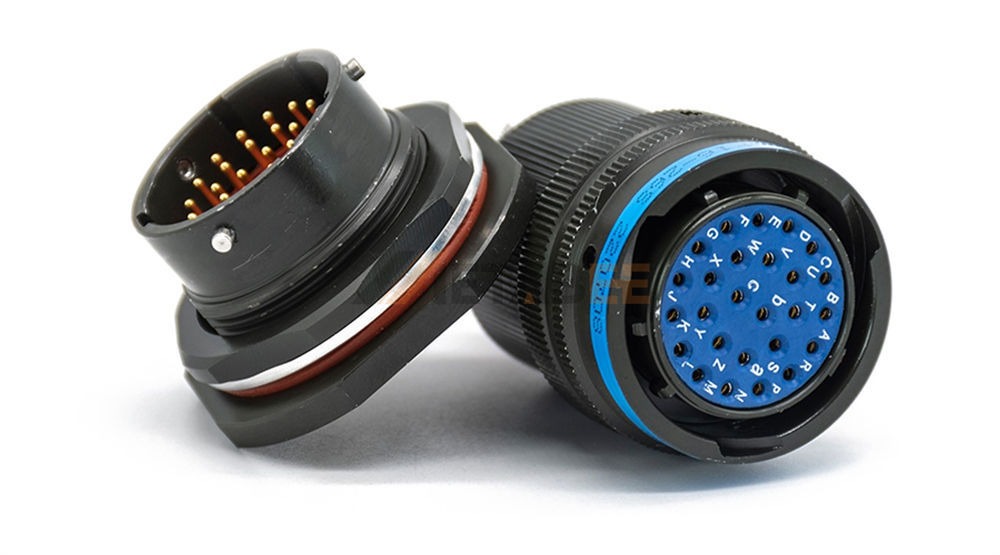
3 Point Bayonet Coupling Mechanism of MIL-DTL-26482 Connectors
Environmental Resistance
- Temperature Range: Operates reliably from -55℃ to +125℃ (-67F to +257F.)
- Corrosion Resistance: Depending on the shell finish, they can withstand salt spray for 48 hours (Nickel plating) or up to 500 hours (Olive Drab Cadmium or Zinc-Cobalt).
Detailed Technical Parameter Table
The following table summarizes the general specifications for MIL-DTL-26482 series connectors:
|
Specification Item |
Technical Data |
|
Coupling Type |
3-Point Bayonet Lock |
|
Shell Sizes |
8, 10, 12, 14, 16, 18, 20, 22, 24 |
|
Contact Sizes |
#20, #16, #12 |
|
Current Rating |
#20: 7.5A, #16: 13A, #12: 23A |
|
Operating Voltage |
Service I: 600V AC, Service II: 1,000V AC |
|
Insulation Resistance |
5000M Ohms (at 500V DC) |
|
Operating Temperature |
-55℃ to +125℃ |
|
Mating Durability |
≥500 Cycles |
|
Shell Material |
Aluminum Alloy (Standard) |
|
Plating Options |
Olive Drab Cadmium, Electroless Nickel, Black Anodized |
|
Insulator Material |
Polychloroprene (Neoprene) or Silicone |
MIL-DTL-26482 Series I vs. Series II: Decoding the Differences
One of the most common questions procurement officers ask is the difference between Series I and Series II. While they share the same mating interface, their internal constructions are different.
Series I
MIL-DTL-26482 Series I is the most widely used version in commercial and light industrial applications.
- Contacts: These typically use solder contacts that are non-removable.
- Insulators: Use a fixed, bonded internal structure.
- Pros: Generally more cost-effective and easier to assemble for simple cable runs where field repair is not expected.
Series II
MIL-DTL-26482 Series II was military-grade.
- Contacts: These feature rear-release crimp contacts. Contacts are crimped onto wires and then inserted into the connector shell.
- Removability: Contacts can be removed and replaced using specific tools, which is vital for field maintenance in aerospace environments.
- Pros: Better sealing performance at high altitudes and easier to repair if a single wire is damaged.
Understanding Insert Arrangements & Polarization
Selecting the correct insert arrangement is perhaps the most critical technical step in the procurement process. It determines not only the number of signals or the amount of power that can be transmitted but also ensures the connector fits the spatial constraints of your device.
Pin Count and Contact Density
The MIL-DTL-26482 standard offers a vast library of arrangements, ranging from simple 2-contact layouts to high-density 61-contact versions.
- Signal Layouts: Utilize smaller #20 contacts for high-density data transmission.
- Power Layouts: Feature larger #16 or #12 contacts to handle higher amperage for motor controls or power distribution.
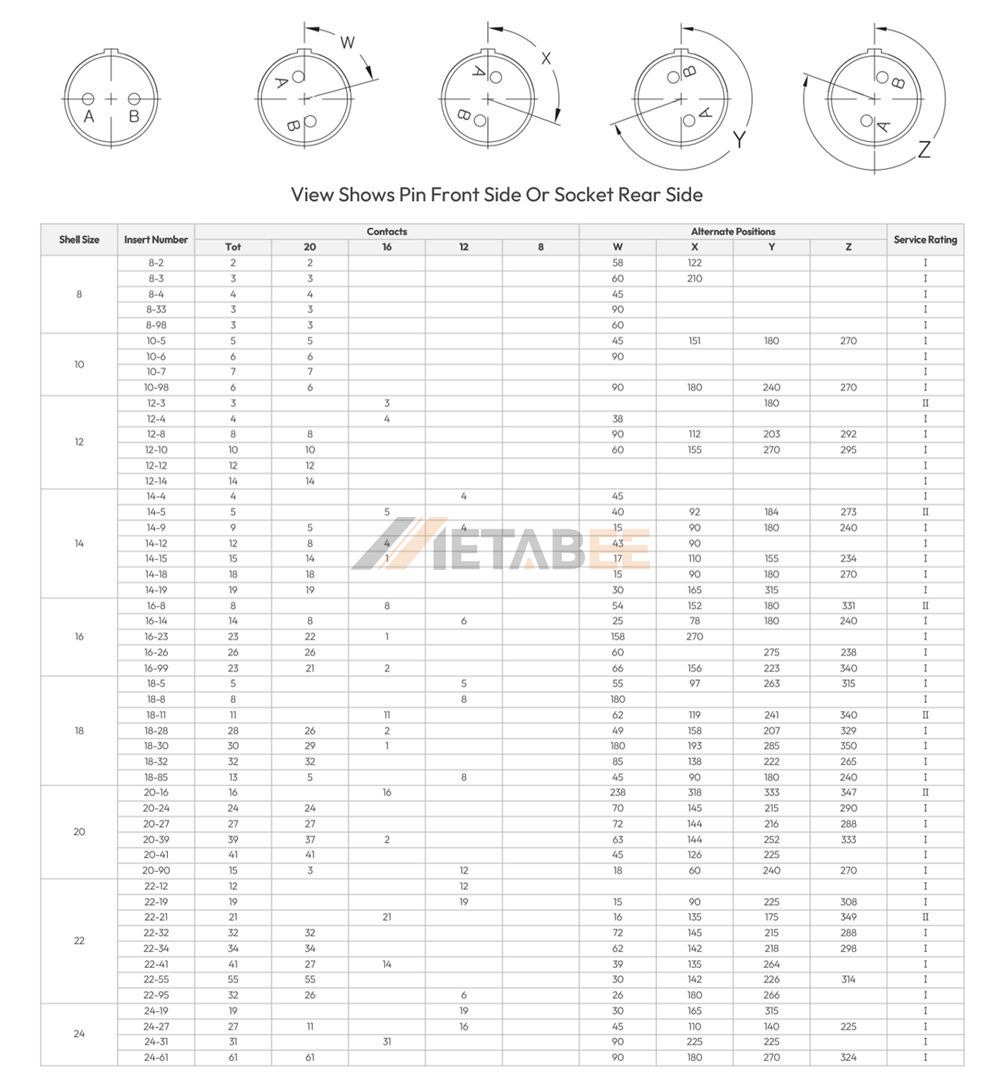
The following is a partial screenshot of the Insert Arrangement for the MIL-DTL-26482 connector. For the complete Insert Arrangement, please download the Metabee MIL-DTL-26482 Connectors Catalog.
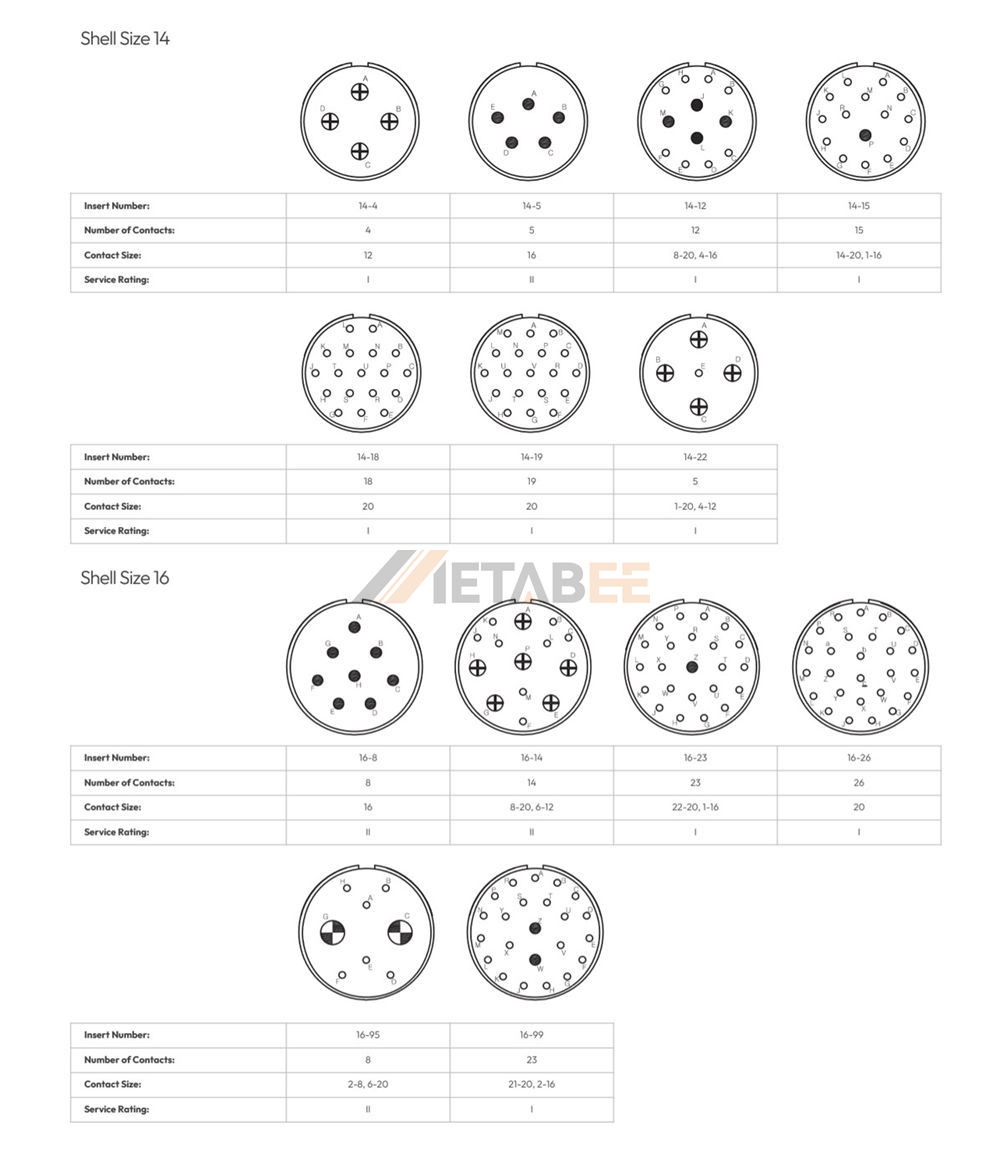
MIL-DTL-26482 Connector Insert Arrangement Sample
Polarization and Rotation (N, W, X, Y, Z)
In complex panels where multiple identical connectors are mounted side-by-side, there is a risk of "mis-mating" (plugging the wrong cable into the wrong receptacle). To prevent this, the standard allows for Insert Rotation. By rotating the insulator within the shell to a specific position (designated as W, X, Y, or Z), manufacturers ensure that only the correctly keyed plug can mate with the corresponding receptacle.
MIL-DTL-26482 Connector Polarization
Discover More: The Metabee MIL-DTL-26482 Catalog
To assist engineers and procurement specialists in selecting the exact arrangement for their projects, we have compiled a comprehensive technical guide.
Our catalog includes detailed dimensional drawings, full contact density maps, and technical cross-reference charts for all shell sizes from 8 to 24.
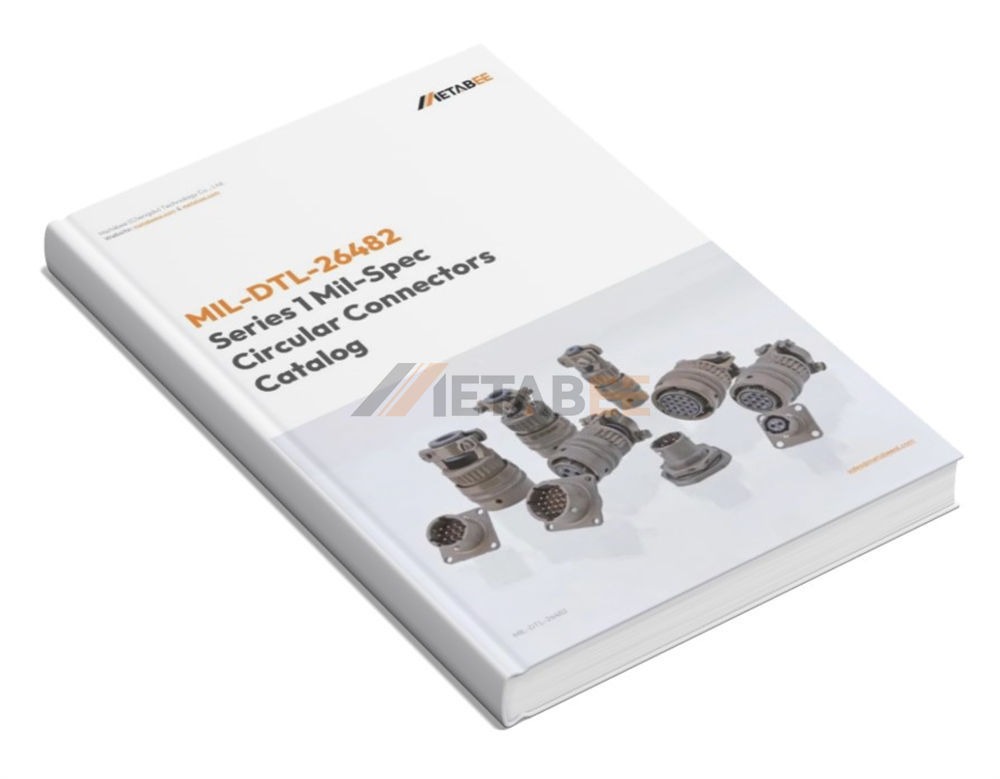
Metabee MIL-DTL-26482 Connectors Catalog
5. Decoding Part Numbers: The Buyer's Guide
Ordering a MIL-DTL-26482 connector can be daunting due to the complex alphanumeric codes. Here is how to break down a typical part number like MS3116F14-19S.
1. Prefix (MS): Indicates Military Standard. Brands may use their own (PT, 851, KPT).
2. Shell Style (3116):
- 3110 / 3470: Wall mount receptacle.
- 3111 / 3471: Cable connecting receptacle.
- 3112 / 3472: Box mount receptacle.
- 3116 / 3476: Straight plug.
3. Service Class (F): Indicates environmental resistance and fluid resistance.
4. Shell Size (14): The diameter of the connector shell. Sizes range from 8 to 24.
5. Insert Arrangement (14-19): This is the layout of the pins. In this case, 14 refers to the shell size, and 19 indicates the specific layout (which happens to have 19 contacts).
6. Insert Rotation (W, X, Y, Z): As discussed in the previous section, these letters indicate a specialized keying position.
7. Contact Gender (S): P for Pin (Male) and S for Socket (Female).
8. The following is the part number specification for Metabee MIL-DTL-26482 Series I Connectors
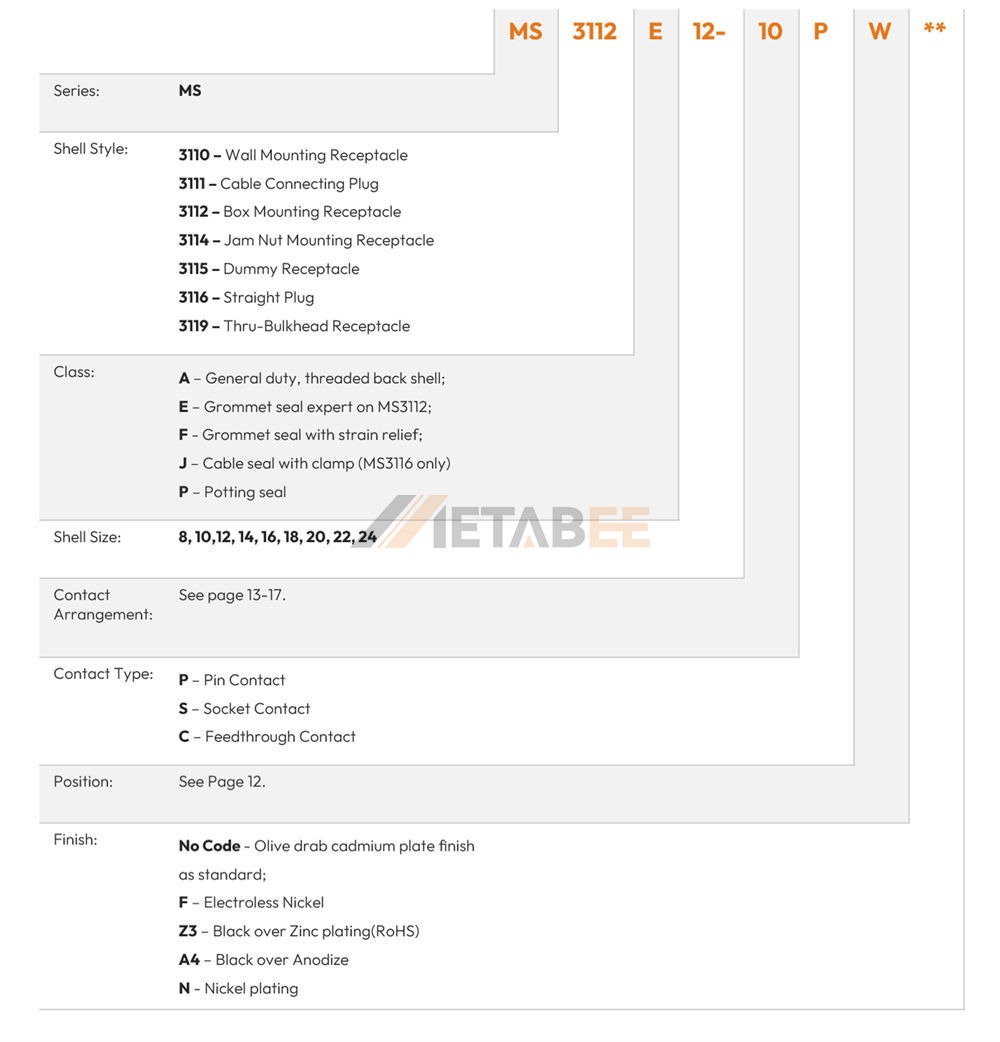
Part Numbers Breakdown of MIL-DTL-26842 Connectors
6. Leading Manufacturers and the Metabee Advantage
Major Manufacturer
- Amphenol (PT Series): The original developer of the PT series, known for an extensive range of commercial options.
- ITT Cannon (KPT/KPSE Series): Highly respected for their engineering precision and reliability in extreme aerospace missions.
- Souriau-Eaton (851 Series): A leader in the European market with a strong focus on industrial ruggedness.
- Metabee (MS Series): Metabee is one of the leading brands in China's connector industry, capable of providing customers with various models of connectors, including MIL-DTL-5015, MIL-DTL-26482, and MIL-DTL-38999.
Why Choose Metabee?
In a global market where lead times can stretch for months and "brand premiums" inflate project costs, Metabee has emerged as a powerful alternative for high-performance circular connectors.
- Strict Military Compliance: Metabee MIL-DTL-26482 connectors are manufactured under rigorous quality control systems. They meet or exceed the performance benchmarks set by the DTL-26482 specification, ensuring they perform in the most mission-critical environments.
- Full Intermateability: One of the biggest concerns for engineers is compatibility. Metabee connectors are 100% intermateable and interchangeable with standard offerings from Amphenol, ITT Cannon, and Souriau. This means you can use a Metabee plug with an Amphenol receptacle without any loss in performance.
- High Quality at Competitive Pricing: By optimizing manufacturing processes and focusing on core high-demand configurations, Metabee offers military-grade durability without the traditional "brand tax." This allows OEMs and distributors to maintain high quality while significantly optimizing their BOM (Bill of Materials) costs.
- Optimized Supply Chain: We understand that time is money. Metabee focuses on rapid lead times and maintaining a healthy inventory of common shell sizes (8, 10, 12, 14, 16) and arrangements, helping you avoid the 20-30 week delays common with larger conglomerates.
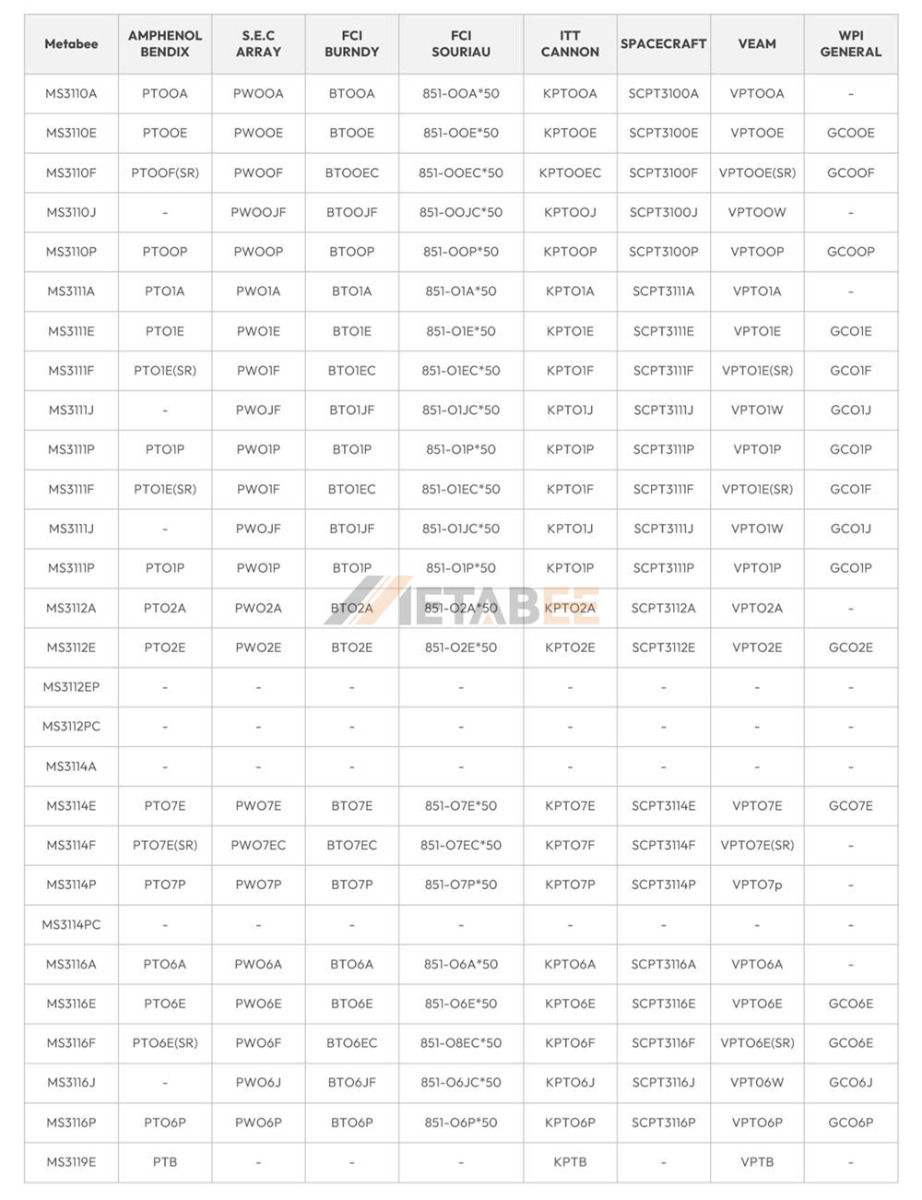
Part Number Cross-Reference Table
To simplify your procurement process, Metabee utilizes standardized part numbering. Whether you are searching for an MS-standard number or an industrial equivalent, our technical team can provide an immediate match.
Conclusion
The MIL-DTL-26482 connector remains one of the most successful designs in engineering history. It has earned this reputation because it solves the fundamental problem of high-reliability connectivity in a compact, easy-to-use package. Whether you are designing the next generation of industrial robots or maintaining a fleet of specialized aircraft, understanding these connectors is vital.
At Metabee, we are committed to providing the global market with connectors that offer uncompromising quality, full compatibility, and superior value.
Ready to upgrade your connectivity?
Check the Metabee MIL-DTL-26482 connectors category or download our MIL-DTL-26482 connector catalog.
Related Products:
Frequently Asked Questions (FAQs):
Q: What is the difference between MIL-C-26482 and MIL-DTL-26482?
A: The difference is primarily administrative. MIL-C-26482 was the original military designation (where "C" stood for Connector). In the late 1990s, the U.S. Department of Defense redesignated it to MIL-DTL-26482 ("DTL" stands for Detail Specification). They are mechanically and electrically identical, interchangeable, and interchangeable.
Q: Can I mate a Metabee 26482 connector with an Amphenol or ITT Cannon version?
A: Yes. One of the primary advantages of the MIL-DTL-26482 standard is strict intermateability. Metabee connectors are designed to be 100% compatible with other leading brands like Amphenol (PT Series), ITT Cannon (KPT Series), and Souriau (851 Series), provided they share the same shell size and insert arrangement.
Q: How do I choose between Series I and Series II?
A: It depends on your assembly and maintenance needs:
- Series I: Best for cost-sensitive or commercial projects. It uses solder contacts that are fixed in place.
- Series II: Ideal for high-reliability military or aerospace applications. It features crimp contacts that can be removed and replaced using specific tools, making field repairs much easier.
Q: What do the W, X, Y, and Z rotations mean in a part number?
A: These letters indicate Insert Rotation (polarization). In environments where multiple identical connectors are used side-by-side, the internal insulator is rotated to a specific angle. This ensures that a plug with a "W" rotation can only mate with a receptacle that has the same "W" rotation, preventing dangerous "mis-mating" errors.
Q: Are MIL-DTL-26482 connectors waterproof?
A: Yes, they are designed for environmental sealing. When properly mated and used with the correct accessories (such as environmental backshells or cable clamps), they typically achieve IP67 or IP68 ratings, making them resistant to moisture, dust, and temporary immersion in water.
Q: What is the maximum current these connectors can handle?
A: The current capacity depends on the contact size:
- Size #20 contacts: Rated for approximately 7.5A.
- Size #16 contacts: Rated for approximately 13A.
- Size #12 contacts: Rated for approximately 23A (some high-performance versions can go up to 35A). Always refer to the specific service class and insert arrangement in the Metabee catalog for exact ratings.
